
Victor Wembanyama Rookie Cards: Complete Guide to Sales, Sets & Market Value
Last updated: July 2026.
 Victor Wembanyama's entry into the NBA arrived with a level of anticipation the league hadn't seen in years. At 7'4" with guard skills and defensive instincts that redefined rim protection, his rookie season validated every bit of the hype. The card market responded accordingly.
Within months of his debut, record-setting sales established Wembanyama among the most valuable modern rookies in basketball. Base rookies that opened under $100 tripled during his playoff run. Population counts climbed into the tens of thousands, creating a market defined as much by liquidity as scarcity.
This is the complete guide to Victor Wembanyama rookie cards—every major sale, every key set, the licensing situation that shaped the market, and the practical guidance collectors need to navigate one of the most complex modern rookie card landscapes in basketball history.

Record-Breaking Sales: The Most Expensive Victor Wembanyama Rookie Cards
The top of the Wembanyama rookie card market is defined by five sales, each exceeding half a million dollars. These aren't accessible cards—they're trophies, 1/1 specimens that exist at the intersection of scarcity, player performance, and collector demand willing to pay prices that reset what modern basketball cards can command.
| Rank | Card | Grade | Sale Price | Date | Platform |
|---|---|---|---|---|---|
| 1 | 2023-24 Panini Prizm Black 1/1 | PSA 10 | $5,110,000 (reported, unverified) | May 2026 | Private sale (Fanatics Collect, reported) |
| 2 | 2023-24 Panini Prizm Nebula Choice #136 1/1 | PSA 9 | $860,100 | February 2025 | Goldin |
| 3 | 2023-24 Panini National Treasures Highly Treasured #HT-WEM patch 1/1 | PSA 10 | $552,050 | May 2026 | Private sale |
| 4 | 2023 National Treasures Rookie Logoman Patch 1/1 | PSA 9 | $528,000 | March 2025 | Private sale |
| 5 | 2024 Panini Revolution Kaboom! Vertical Green 1/1 #15 | PSA 9 | $516,000 | February 2026 | Private sale |
Platform information for sales #3-5 not disclosed in source reporting.
These sales establish Wembanyama's position alongside LeBron James, Giannis Antetokounmpo, and Luka Dončić as a modern player whose cards drive six-figure and seven-figure transactions. The ceiling is set. The floor, for most collectors, lives several tiers below.
 2023-24 Panini Prizm Black 1/1 — $5,110,000 (reported, unverified)
According to reporting by The Athletic, the 2023-24 Panini Prizm Black 1/1, graded PSA 10, reportedly sold privately in May 2026 through Fanatics Collect for $5,110,000. This sale has not been independently verified through public auction records or confirmed by Fanatics, PSA, or other third-party sources. If verified, this would represent the most expensive non-autographed NBA card in history.
The Black parallel sits at the top of Panini's Prizm hierarchy—one card printed, serial numbered 1/1, with a deep black border that contrasts sharply against Prizm's chromium card stock. The PSA 10 grade confirms near-perfect centering, corners, edges, and surface.
The Athletic's reporting noted the buyer confirmed the card's legitimacy despite a brief controversy involving the original submitter—the PSA 10 grade stood, and the sale reportedly moved forward at the stated price. The transaction occurred during Wembanyama's first playoff run, a 14-game stretch where he averaged 21.6 points, 12.4 rebounds, 5.0 blocks, and 3.9 assists.
If confirmed, this reported sale would rank as the fourth-highest NBA card sale overall, trailing only autographed examples from Michael Jordan and LeBron James.

2023-24 Panini Prizm Nebula Choice 1/1 — $860,100
Before the reported Black 1/1 sale, the Nebula Choice parallel held the Wembanyama record. This 1/1, graded PSA 9, sold through Goldin in February 2025 for $860,100.
Nebula parallels feature a swirling, multicolor refractor effect—visually striking, highly collectible, and among the scarcest Prizm variations outside the Black 1/1. Nebula cards have developed a dedicated following among chromium card collectors who value the aesthetic as much as the scarcity.
The PSA 9 grade—one point below Gem-Mint—likely cost this card a premium relative to what a PSA 10 would have commanded, but at this level of scarcity, the card itself drives value more than the grade.
 2023-24 Panini National Treasures Highly Treasured Patch 1/1 — $552,050
National Treasures represents Panini's ultra-premium basketball brand—low print runs, game-used patches embedded in the card, thick card stock, and packaging designed to signal exclusivity. The Highly Treasured subset sits at the top of that already-elevated tier.
This 1/1, graded PSA 10, sold in May 2026 for $552,050. The card includes a game-used patch—a piece of jersey material worn during an NBA game and embedded directly into the card design. National Treasures patches combine scarcity, premium presentation, and tangible connection to on-court performance.

2023 National Treasures Rookie Logoman Patch 1/1 — $528,000
The Logoman patch—the silhouetted dribbling player woven into game-worn jerseys, representing the NBA's official logo—is among the most coveted patch types in basketball cards. Only one Logoman patch exists per jersey. When that patch is embedded into a 1/1 card of a generational talent's rookie year, collectors respond.
This National Treasures Logoman 1/1, graded PSA 9, sold in March 2025 for $528,000. The card is from the 2023 National Treasures release—released ahead of Wembanyama's official NBA rookie season but still considered part of his rookie card class by most collectors and grading standards.
Logoman patches carry emotional weight beyond scarcity. They are the literal logo of the league, embedded in a card.
 2024 Panini Revolution Kaboom! Vertical Green 1/1 — $516,000
Revolution Kaboom! inserts are instantly recognizable—bold, pop-art aesthetic, explosive color gradients, and a design language that looks nothing like traditional basketball cards. Kaboom! cards have developed a dedicated following among collectors who value visual impact as much as traditional scarcity metrics.
This Vertical Green 1/1, graded PSA 9, sold in February 2026 for $516,000. The Vertical format refers to the card's orientation—Kaboom! inserts are printed taller than standard cards, emphasizing the explosive design.

Understanding Wembanyama's Rookie Card Licensing Situation
Victor Wembanyama's rookie card market is shaped by a licensing dynamic that created a bifurcation between autograph rights and NBA imaging rights during his 2023-24 rookie season.
During the 2023-24 NBA season, Panini held the exclusive NBA license—meaning every officially licensed NBA card featuring team logos, uniforms, and league marks was produced by Panini. However, Topps (now under Fanatics ownership) secured an exclusive autograph agreement with Wembanyama before his rookie season began. This created a split: Panini could produce NBA-licensed rookie cards but could not include Wembanyama's autograph. Topps held the autograph rights but did not hold the NBA license for Wembanyama's rookie season.
The practical result: no officially licensed NBA autographed Victor Wembanyama rookie cards exist. Panini's cards are licensed but unsigned. Topps has released unlicensed Wembanyama autographed cards from his pre-NBA career—these cards feature player images and autographs but do not display team logos or league marks.
This licensing gap occurred because the NBA's exclusive license transition from Panini to Fanatics/Topps coincided with Wembanyama's rookie year. The autograph contract landed with the incoming license holder (Topps/Fanatics) rather than the outgoing one (Panini), creating a one-year window where Panini held NBA imaging rights but not autograph rights for this specific player.
For collectors, this means the entire Wembanyama rookie card market is defined by unsigned Panini cards, with value driven by scarcity, parallels, patches, and grading rather than autographs. The licensing situation is a structural artifact of timing—not a permanent feature of the market—but it shapes the entire rookie year card landscape for this player.
Key Wembanyama Rookie Card Sets: Panini's 2023-24 Releases
Panini released multiple basketball sets during Wembanyama's 2023-24 rookie season, each serving a different market tier and collector intent. The sets below represent the primary options—from entry-level accessibility to ultra-premium exclusivity. Every set contains a base Victor Wembanyama rookie card and a range of parallels with varying print runs and price points.
 Panini Prizm #136 — The Flagship Wembanyama Rookie
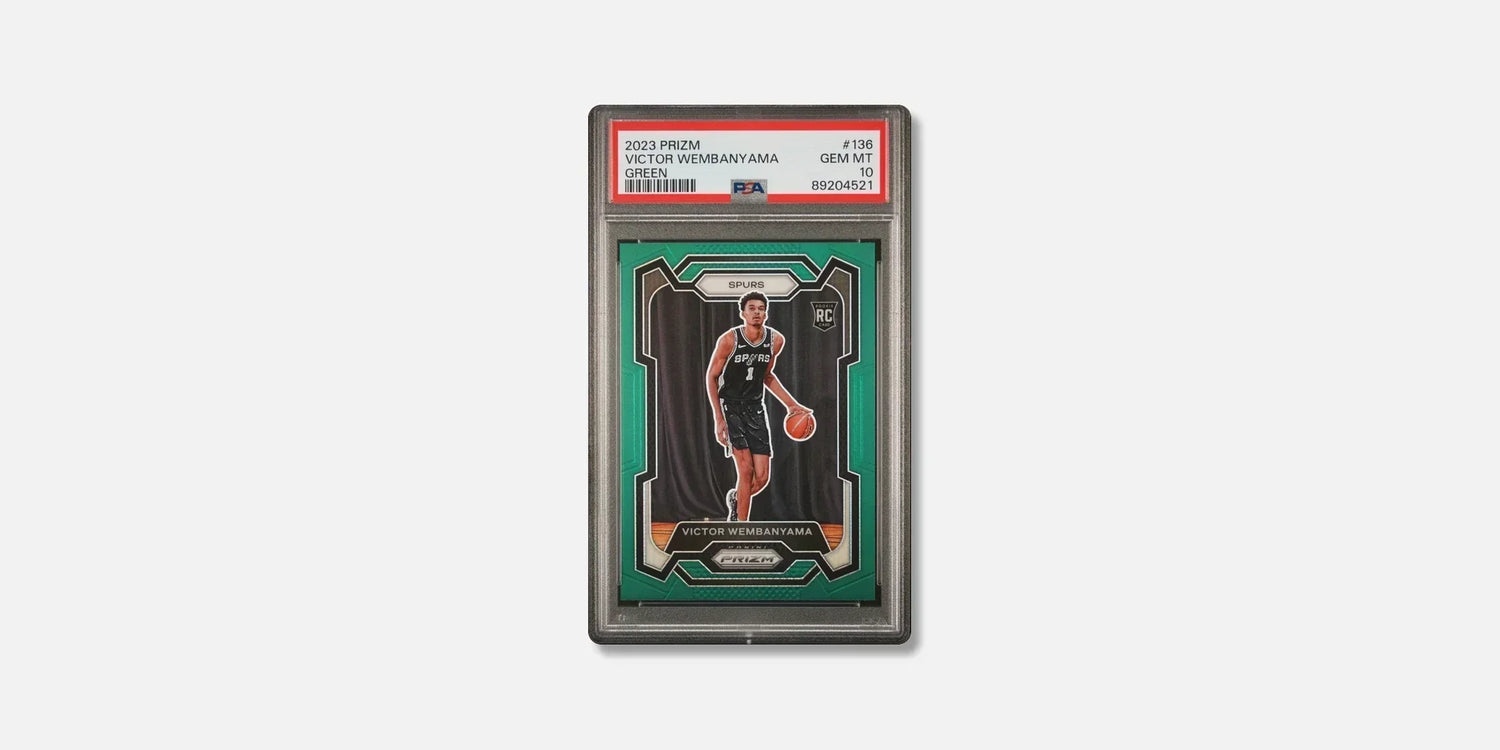
Panini Prizm is the most recognized modern basketball card brand. Chromium card stock with metallic shine, extensive parallel structure, and a collector base that spans from casual fans to serious investors. The 2023-24 Panini Prizm Victor Wembanyama #136 base rookie is the card most collectors think of first when they hear "Wembanyama rookie card."
The population reality: over 27,000 PSA 10 base Prizm Wembanyama rookies have been graded as of May 2026. That's the sixth-highest graded card population of any athlete in history. High population means high liquidity—these cards trade constantly—but also means scarcity isn't the primary value driver. Demand is.
Base Prizm PSA 10s were selling for under $100 in February 2025. By May 2026, during Wembanyama's playoff run, those same cards were trading around $390. That's a 3x increase in three months, driven entirely by on-court performance and collector demand.
Key Prizm parallels include Silver Prizm (the most popular parallel, slightly lower print run than base), Tiger Stripe or Color Blast parallels (rainbow refractor effects), Nebula (multicolor swirl), Cracked Ice parallel, and the ultra-premium 1/1s like Black and Nebula Choice. Each parallel tier represents a lower print run and higher price point.
The Prizm base rookie is the most liquid Victor Wembanyama rookie card. If you want to buy or sell quickly, this is the card. If you're building a Wembanyama PC and want the most recognized rookie, this is the card.
 Panini Hoops #277 — Entry-Level Accessibility
Hoops is Panini's mass-market basketball brand. High print runs, lower price points, and wide retail availability make Hoops the entry point for collectors new to the hobby or those building complete sets without premium budgets.
The 2023-24 Panini Hoops Victor Wembanyama #277 base rookie is the most affordable major Wembanyama rookie card. Base PSA 10s were selling for $25-$45 in February 2025. By May 2026, those same cards were selling for over $100—still accessible, but reflecting the same playoff-driven price surge that affected every Wembanyama rookie.
Hoops parallels include Premium Stock (thicker card stock), Artist Proof, and various numbered inserts. The parallel structure is less extensive than Prizm, but the base card's affordability makes it the natural choice for collectors who want to own a graded Wembanyama rookie without spending several hundred dollars.
For newer collectors entering the market, Hoops offers a genuine Victor Wembanyama rookie card at a price point that doesn't require significant financial commitment.
 Donruss Optic #225 — The Chromium Alternative
Donruss Optic serves collectors who want chromium card stock and refractor aesthetics without paying Prizm prices. The visual appeal is similar—metallic finish, parallel variations with refractor effects—but Optic historically trades at a discount to Prizm.
The 2023-24 Donruss Optic Victor Wembanyama #225 Holo parallel is the most popular Optic card among collectors. The Holo parallel features a rainbow refractor effect and sits at the sweet spot between accessibility and premium presentation. Holo PSA 10s were selling around $300 in February 2025. By May 2026, those same cards were trading around $1,100.
Optic's appeal is straightforward: chromium card collectors who don't want to pay Prizm premiums but still want a visually striking card choose Optic. The Holo parallel specifically has become a go-to choice for player collectors building PCs across multiple rookies.
 Panini Select — Tri-Color Die-Cuts and Parallels
Select is known for its die-cut tri-color design—cards are cut with rounded corners and feature three-color borders that visually distinguish them from standard rectangular cards. The design is polarizing. Some collectors love the aesthetic distinctiveness. Others prefer traditional card shapes.
Select uses a tiered parallel structure: Concourse (base level), Premier Level (mid-tier), and Courtside (premium tier). Each tier has its own color scheme and print run, creating a built-in scarcity hierarchy within the same product.
Select appeals to set builders and parallel collectors who value the brand's unique design language. The tri-color die-cut format makes Select cards immediately recognizable in a display case.
Panini National Treasures — Ultra-Premium Patches and Logomans
National Treasures sits at the top of Panini's price pyramid. Low-numbered cards, game-used patches, premium packaging, and a brand identity built around exclusivity. National Treasures boxes retail for thousands of dollars. The cards inside are designed for high-end collectors and investors, not casual buyers.
Victor Wembanyama's National Treasures rookies include patch cards with embedded jersey material, Logoman patches, and various 1/1 parallels. Multiple National Treasures 1/1s have sold for over half a million dollars—these are trophy cards, not everyday collectibles.
For most collectors, National Treasures represents the aspirational tier. You don't casually buy these cards. You acquire them as centerpieces, often through auction or private sale.
Other Notable Sets: Chronicles, Revolution, Mosaic, Premium Stock
Panini released several additional sets containing Victor Wembanyama rookies, each with its own positioning and collector base. Chronicles is a multi-brand compilation set that includes cards styled after Panini's other brands—a sampler format popular among set builders. Revolution is known for its Kaboom! inserts, which feature explosive pop-art aesthetics and have developed a dedicated following. Mosaic offers another chromium option with a stained-glass parallel theme. Premium Stock uses thicker, heavier card stock for a premium tactile feel.
None of these sets are primary market drivers the way Prizm, Hoops, or National Treasures are, but they expand the Wembanyama rookie card landscape for collectors who want variety beyond the flagship releases.

Wembanyama 1/1 Rookie Cards: Scarcity and Six-Figure Sales
A card with a print run of exactly one copy—the rarest possible version of any card, often denoted by serial number '#1/1' on the card—represents the absolute peak of scarcity in modern basketball cards. Every major Panini set releases multiple 1/1 parallels for each player, each with different color treatments, finishes, or embedded materials. For Victor Wembanyama, those 1/1s have commanded six-figure and seven-figure prices.
The five highest publicly reported Wembanyama 1/1 sales are documented in the table above: the reported $5,110,000 for the Prizm Black (unverified), $860,100 for the Nebula Choice, $552,050 for the National Treasures Highly Treasured Patch, $528,000 for the Logoman Patch, and $516,000 for the Revolution Kaboom! Vertical Green.
Many additional Wembanyama 1/1s exist but haven't been sold publicly. These include various Prizm color parallels, National Treasures patch variations, and insert sets across multiple releases. The cards documented above represent the known sales—the 1/1s that changed hands publicly and set price precedents for future transactions.
Owning a Wembanyama 1/1 means owning the only copy of that specific card in existence. No one else can own the same card. That exclusivity drives prices beyond what print run alone would suggest.
Market Trajectory: How Wembanyama's Playoff Performance Drove Prices
The Victor Wembanyama rookie card market didn't move in a straight line. It moved in response to performance—specifically, his 2026 playoff run.
In February 2025, base Prizm PSA 10s were selling for under $100. Hoops base PSA 10s were trading in the $25-$45 range. Optic Holo PSA 10s were around $300. These were the prices before the playoffs began, when Wembanyama was still viewed as a promising rookie with potential but not yet proven in the postseason.
Then the playoffs happened. Wembanyama averaged 21.6 points, 12.4 rebounds, 5.0 blocks, and 3.9 assists per game through 14 playoff games, leading the Spurs deeper into the postseason than most analysts predicted. On May 18, 2026, he posted 41 points and 24 rebounds in a double-overtime playoff game—a performance that immediately drove collector interest across the market.
By the end of May 2026, base Prizm PSA 10s were selling for $390—nearly a 4x increase. Hoops base PSA 10s had climbed above $100. Optic Holo PSA 10s were trading around $1,100. The reported $5,110,000 Prizm Black 1/1 sale happened during this same window.
The price appreciation wasn't random speculation—it responded directly to Wembanyama validating his generational talent designation at the highest stakes. The market doesn't just track stats; it responds to whether a player performs when elimination is on the line. Wembanyama's 2026 playoff run demonstrated that his regular-season dominance translated to postseason competition, which shifted collector sentiment from "he might become" to "he is becoming." That shift drives demand, and demand drives price.
Collectors who bought in February 2025 saw 3-4x returns within months. Collectors who waited until the playoff hype peaked paid significantly more. On-court performance drives demand, and demand drives price.
Whether those prices hold depends on what happens next. Championship success, MVP awards, sustained dominance—all of these could push prices higher. Injury, plateau, or simply market correction could bring them back down.
Population Reports and Supply: Why PSA 10 Counts Matter
A population report—a database maintained by grading companies showing how many copies of a specific card have been graded at each grade level—is one of the most important tools for understanding modern card values. For Victor Wembanyama, the population numbers tell a story most collectors don't instinctively expect.
The 2023-24 Panini Prizm Victor Wembanyama #136 base rookie has over 27,000 PSA 10s graded as of May 2026. That's the sixth-highest graded card population of any athlete in history. By comparison, most vintage cards from the 1950s and 1960s have PSA 10 populations in the single digits or low hundreds. Even modern rookies from the early 2000s rarely crack 10,000 PSA 10s.
High population means high liquidity—there are enough PSA 10 Prizm Wembanyama base rookies in circulation that buying and selling happens constantly. You can find one on eBay at almost any hour. Demand drives value here, not scarcity.
This is a fundamental shift in how modern card markets work compared to vintage markets. A 1952 Topps Mickey Mantle PSA 10 is valuable because fewer than 10 exist. A Wembanyama Prizm PSA 10 is valuable because tens of thousands of collectors want one, and on-court performance keeps demand elevated despite massive supply.
For collectors, this means understanding population counts before buying. A low-numbered parallel with a population of 50 PSA 10s behaves differently than a base card with 27,000. The low-pop card might appreciate faster if demand increases, but it will also be harder to sell quickly. The high-pop card trades more like a liquid commodity—easier to move, but subject to broader market swings.
Investment vs. Collection: Which Wembanyama Cards Make Sense for Your Goals
Not every collector buys cards for the same reason. Some are building a personal collection of a favorite player. Some are speculating on future appreciation. Some are chasing the thrill of owning a 1/1 trophy card. The right Wembanyama rookie depends entirely on which goal you're pursuing.
If you're building a PC—your personal collection of cards you intend to keep long-term—prioritize cards that mean something to you beyond price. The base Prizm or Hoops rookie is a genuine representation of Wembanyama's rookie year, licensed and widely recognized. A specific parallel that appeals to you visually is worth more in your collection than a card you bought only because it was underpriced.
If you're speculating—buying with the expectation of selling later for profit—consider liquidity and potential upside. High-population base cards like the Prizm PSA 10 trade constantly, which means you can exit the position quickly if prices move. Lower-numbered parallels offer more upside potential if Wembanyama wins MVP or a championship, but they're harder to sell quickly because the buyer pool is smaller.
If you're chasing 1/1s or six-figure cards, understand that you're buying trophies, not liquid assets. A reported $5,110,000 Prizm Black isn't something you flip for a quick profit. It's a singular piece with a market of one buyer at a time. These cards appreciate or depreciate based on Wembanyama's career trajectory and the broader willingness of ultra-high-net-worth collectors to pay record prices.
The question isn't "which Victor Wembanyama rookie card is the best?" The question is "which card fits the role you need it to play in your collection or portfolio?"
Protecting Your Wembanyama Rookie Cards
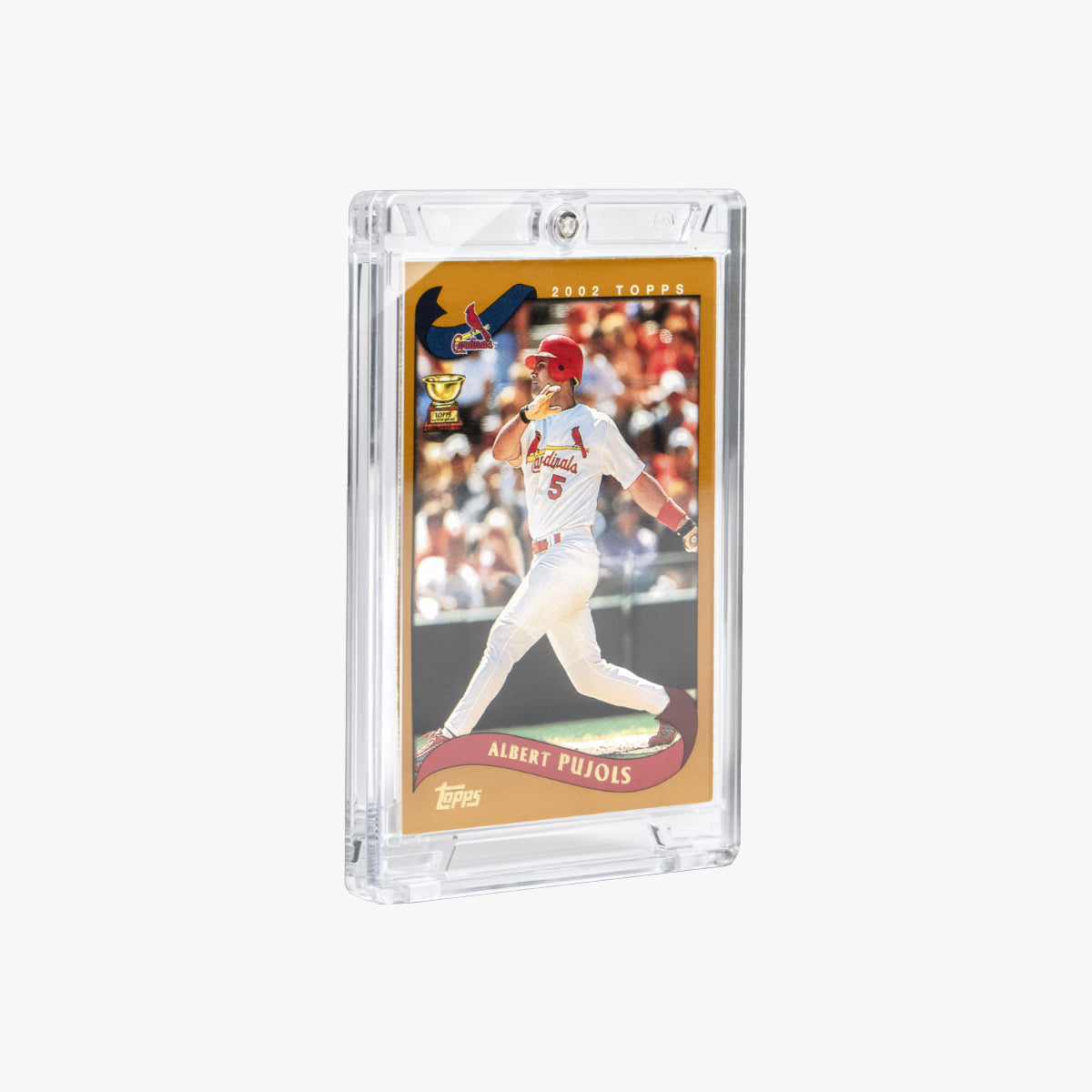
Cards worth hundreds or thousands of dollars deserve storage that matches their value. Raw cards go in penny sleeves and toploaders as a baseline. Magnetic holders work for raw cards you're considering submitting to PSA or BGS. Graded slabs protect cards from handling and environmental contact, but even with a graded slab, long-term UV exposure remains a consideration for collectors.
For collectors displaying graded Wembanyama rookies, UV-protective cases add a layer of protection the slab itself isn't designed to provide. The Card Display Plus (PSA/CGC) includes a UV-protective polycarbonate window and magnetic mounting system designed for PSA and CGC graded cards.
Storage isn't just about protection from damage—it's about preserving the card in the condition it's in today. A PSA 10 Wembanyama Prizm stored poorly can degrade over years of UV exposure or humidity fluctuations. The same card stored properly maintains the grade and the value that grade represents.
Keep cards away from windows, avoid rooms with significant natural light, and maintain stable temperature and humidity. Storage products provide protection. The environment determines whether that protection is enough.
Frequently Asked Questions About Victor Wembanyama Rookie Cards
What is Victor Wembanyama's most expensive rookie card?
According to reporting by The Athletic, the 2023-24 Panini Prizm Black 1/1, graded PSA 10, reportedly sold privately in May 2026 for $5,110,000 through Fanatics Collect. This sale has not been independently verified. If confirmed, it would represent the most expensive non-autographed NBA card ever sold and the fourth-highest NBA card sale overall.
Does Victor Wembanyama have any autographed rookie cards?
No officially licensed NBA autographed Victor Wembanyama rookie cards exist. Panini held the NBA license during his 2023-24 rookie season but did not have his autograph rights. Topps has Wembanyama under exclusive autograph contract with Fanatics but cannot produce NBA-licensed cards from his rookie season. Topps has released unlicensed autographed cards from Wembanyama's collegiate career.
What is the best Victor Wembanyama rookie card to buy?
The best card depends on budget and collecting goals. For entry-level collectors, the Hoops base PSA 10 offers genuine rookie card status at an accessible price point—over $100 as of May 2026. For mid-tier buyers, the Prizm base PSA 10 is the most liquid and widely recognized Wembanyama rookie, trading around $390. For premium collectors, Prizm parallels, Optic Holo, and National Treasures patch cards offer scarcity and visual appeal at significantly higher price points. There is no single "best"—match the card to your intent.
How many Victor Wembanyama Prizm rookie cards have been graded PSA 10?
Over 27,000 as of May 2026. This is the sixth-highest graded card population of any athlete in history. High population means high liquidity—these cards trade constantly—but also means scarcity isn't the primary value driver. Demand, driven by Wembanyama's on-court performance and collector interest, is what elevates prices despite massive supply.
Are Victor Wembanyama rookie cards a good investment?
Cards are collectibles, not financial instruments. Wembanyama's playoff performance in 2026 drove significant short-term price appreciation—base Prizm PSA 10s tripled in value from February to May 2026, Hoops base PSA 10s more than doubled, and Optic Holo PSA 10s increased nearly 4x. Long-term value depends on career trajectory, championship success, and sustained collector demand. High-population base cards offer liquidity and ease of exit. Low-numbered parallels offer potential upside but lower liquidity. Auction results demonstrate sustained demand at current price levels—what happens next depends on factors no collector can predict with certainty.
What is the difference between a base rookie and a parallel?
A base rookie is the standard, non-parallel version of a player's rookie card from a given set—typically the highest-printed version. A parallel is a variation of a base card with different color borders, foil treatments, or finishes, typically with lower print runs than the base version. Examples include Silver Prizm, Holo, Nebula, and Black. Parallels are generally more scarce and command higher prices than base versions, but the base rookie remains the most widely collected and liquid card for any given player.
Should I submit my Victor Wembanyama rookie cards to PSA for grading?
Grading makes sense for cards likely to receive a PSA 9 or PSA 10 grade, where the grading cost plus the card's raw value is lower than the expected graded value. For high-value rookies like Wembanyama Prizm or Optic, the price difference between a raw card and a PSA 10 is often significant enough to justify submission—but only if the card's condition supports a top grade. Cards with visible centering issues, corner wear, or surface damage rarely grade high enough to justify the cost. If you're uncertain about a card's condition, consult PSA's grading standards or an experienced collector before submitting.
Victor Wembanyama's rookie card market is defined by contradictions: record-breaking sales and accessible base cards, massive populations and genuine scarcity at the top, licensed NBA cards without autographs. More than a few collectors entering this market don't know these distinctions exist until they've already overpaid for the wrong card or missed the right opportunity. Understanding what makes each card valuable—and why certain cards that look similar trade at wildly different prices—is what separates informed collecting from expensive guesswork. That's what this guide was built to fix.