



Bo Jackson Rookie Card Guide: Values, Grades, and Top Cards for Collectors
Last updated: July 2026.
Why Bo Jackson Rookie Cards Remain Iconic
Bo Jackson is one of the few athletes in history to be named an All-Star in two major professional sports. He played in the 1989 MLB All-Star Game and the 1990 NFL Pro Bowl—a dual achievement that places him alongside a select group including Deion Sanders.
Jackson played 694 Major League Baseball games but only 38 NFL games before a career-ending hip injury in 1991. Those 38 games produced a 1990 Pro Bowl selection and a Monday Night Football run that became one of the most replayed highlights in sports history. His baseball career lasted longer—seven seasons with the Kansas City Royals, Chicago White Sox, and California Angels—but never reached the statistical dominance his physical tools suggested.
What Jackson lacked in longevity he made up for in cultural impact. Nike's "Bo Knows" campaign turned him into something bigger than statistics: a symbol of athletic possibility. The 1985 Heisman Trophy winner at Auburn became a crossover icon who appeared in video games, commercials, and highlight reels that defined late-1980s sports culture. That cultural weight drives demand for his rookie cards three decades after issue.
His rookie cards were issued during the Junk Wax Era, when massive overproduction resulted in most cards having little value unless in top grades. Premium parallels, limited-distribution issues, and high-grade examples of condition-sensitive designs create the separation. Scarcity in PSA 10 matters more than historical production volume.
Understanding Bo Jackson's Rookie Card Timeline
Bo Jackson's rookie card landscape requires a timeline to make sense of it.
An Extended Rookie Card (XRC) appears first—a card issued in an update or traded set before the player's base-year rookie cards. The 1986 Topps Traded Bo Jackson cards are XRCs. His 1987 base-year issues are true rookie cards. Both are legitimate Bo Jackson rookie cards. The distinction matters because collectors sometimes assume only one version counts.
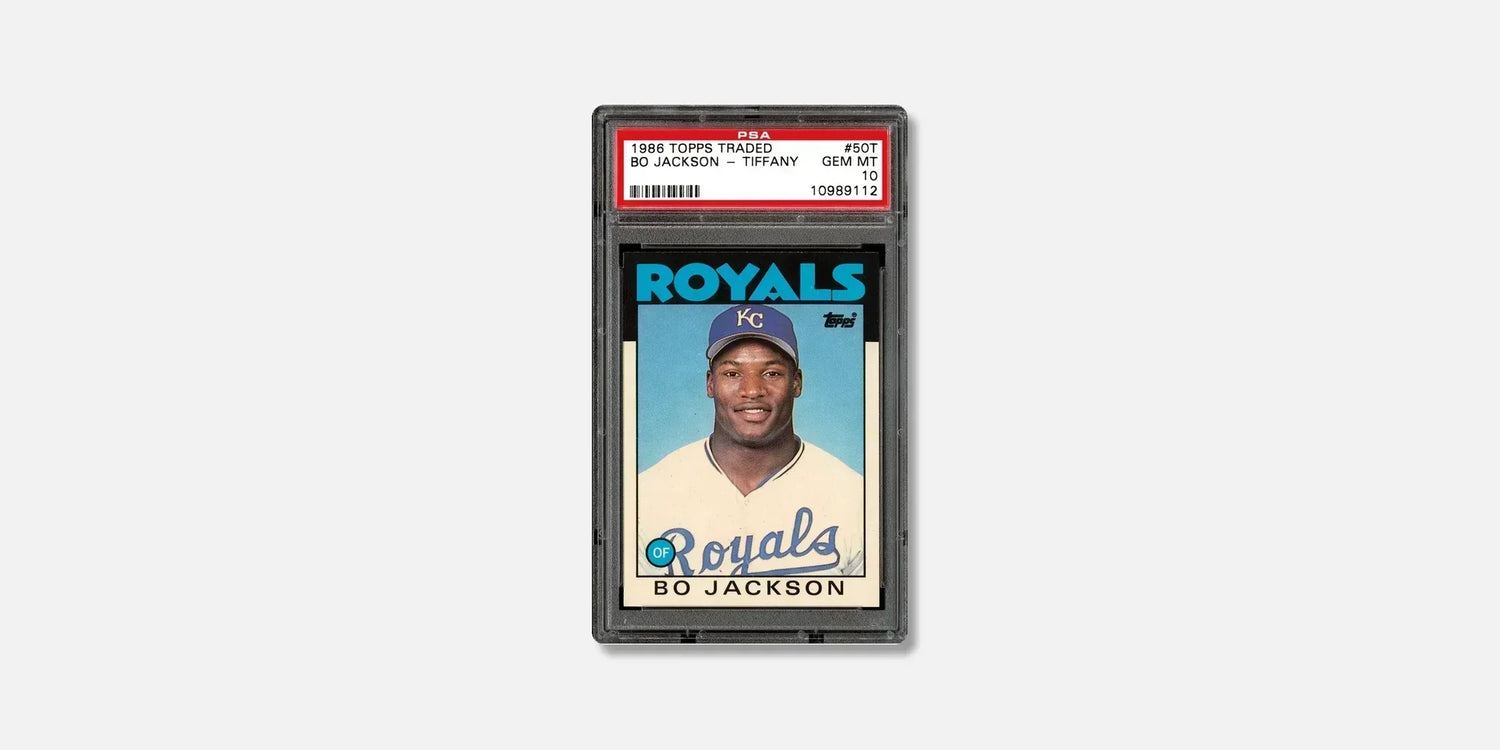
Jackson signed with the Kansas City Royals in 1986 after initially declining the Tampa Bay Buccaneers' NFL draft selection. Topps issued his first card in the 1986 Topps Traded set—an update set distributed after the base Topps release. The 1986 Topps Traded #50T appeared in both base factory sets and the premium Tiffany parallel, which was printed on higher-quality glossy cardstock and distributed in limited factory sets.
His true base-year rookies followed in 1987: Topps #170, Donruss #35, Fleer #369, and the Canadian-market Leaf #35. Each had base versions and premium parallels—Topps and Fleer offered Tiffany and Glossy versions respectively, printed with limited distribution.
Jackson's lone mainstream football rookie card came later: 1988 Topps Football #327, issued after his 1987 NFL season with the Los Angeles Raiders.

The Most Valuable Bo Jackson Rookie Card: 1986 Topps Traded Tiffany #50T
 The 1986 Topps Traded Tiffany #50T is Bo Jackson's most valuable rookie card. A PSA 10 copy sold for $12,300 in June 2021 according to multiple hobby sources including PWCC, eBay auction records, and reports from Sports Illustrated Collectibles—the highest documented sale for any Bo Jackson rookie card.
Topps printed only 5,000 total 1986 Topps Traded Tiffany factory sets. Every card in those sets used glossy cardstock with a premium finish that differentiated it immediately from the base Topps Traded version. The limited print run created genuine rarity in an era defined by overproduction.
Only 37 PSA 10 copies exist across approximately 700 total PSA submissions. Condition sensitivity on glossy cardstock meant most copies that survived 35 years came back graded PSA 8 or PSA 9. Corners show wear. Centering issues knock cards down. Surface scratches that would be invisible on matte stock become immediately apparent on Tiffany's glossy finish.
The base 1986 Topps Traded #50T provides the comparison. That version has 1,100 PSA 10 copies—nearly 30 times the Tiffany population. According to auction records, a PSA 10 base Traded sold for $670 in January 2024. Same design, same player, dramatically different scarcity and value.
For collectors building a premium Bo Jackson collection, the Tiffany is the centerpiece. It separates itself from Junk Wax Era valuation because the fundamentals—limited production, low surviving population in top grades—work the same way they do for pre-war tobacco cards or 1950s Topps high numbers.
1987 Base-Year Bo Jackson Rookie Cards
Jackson's true rookie cards appeared in 1987 across four major manufacturers. These are base-year issues—not update sets—and each was printed during peak Junk Wax Era production. Print runs numbered in the millions. Raw or low-grade copies are worth little. High-grade examples command premiums because condition-sensitive designs make PSA 10s harder to obtain than population counts suggest.
1987 Topps Bo Jackson Rookie #170
 The 1987 Topps Bo Jackson rookie is the most widely recognized of his baseball rookies. It appeared in the standard Topps base set—the one sold in wax packs at every convenience store and card shop in America. Millions were printed.
PSA 10 copies of the base 1987 Topps #170 typically trade in the $150-$250 range based on recent eBay sold listings as of July 2026. The Tiffany parallel changes the equation. Topps Tiffany sets from 1986-1991 had significantly smaller print runs than base sets. The 1987 Topps Tiffany #170 has 400 PSA 10 copies and PSA 10 examples typically trade in the $400-$600 range—a meaningful premium reflecting its status as a limited parallel from this era.
1987 Donruss Bo Jackson Rookie #35
 The 1987 Donruss Bo Jackson rookie has black borders on all four sides. Any edge wear, any chipping, any print defect shows immediately against solid black. That condition sensitivity makes this card harder to grade than its population suggests.
Despite that, 1,300 PSA 10 copies exist. The number seems high until you consider how many millions of 1987 Donruss cards were printed during the peak Junk Wax Era. Most copies that get submitted come back PSA 8 or PSA 9. Corners soften. Edges chip. Centering drifts. The black borders don't forgive.
According to auction records, a PSA 10 sold for $510 in March 2021—a peak-market sale during the hobby's post-COVID boom.
1987 Fleer Bo Jackson Rookie #369
 Fleer issued two versions of its 1987 set: the standard base issue and the Glossy parallel. The Glossy parallel was a premium version printed with glossy coating and distributed in limited quantities similar to Topps Tiffany.
The base 1987 Fleer Bo Jackson has 600 PSA 10 copies. The Glossy version has 150 PSA 10s—one-quarter the base population. Based on recent eBay sold listings and auction comps, base PSA 10 examples typically trade in the $100-$175 range, while Glossy PSA 10s command $250-$400—demonstrating that scarcity drives a meaningful premium despite both being issued during the same Junk Wax Era production cycle.
Fleer's design uses a distinctive diagonal stripe and bold team name treatment. For investors, the Glossy parallel offers the better long-term hold due to constrained supply.
1987 Leaf Bo Jackson Rookie #35
 The 1987 Leaf Bo Jackson is the second most valuable Bo Jackson baseball rookie after the 1986 Topps Traded Tiffany. According to auction records, a PSA 10 sold for $2,850 in December 2023.
The 1987 Leaf set was distributed primarily in the Canadian market and has card backs printed in both English and French. Limited U.S. availability meant fewer cards entered circulation compared to Topps, Donruss, and Fleer base issues that flooded American card shops and retail stores.
Only 100 PSA 10 copies exist. That population count sits between the ultra-scarce 1986 Tiffany (37 PSA 10s) and the high-population base issues like Donruss (1,300 PSA 10s). The Leaf occupies a middle tier: scarce enough to command a premium, available enough that determined collectors can acquire one without chasing auction records.
The design uses clean photography and understated borders that age well. The bilingual card back adds a distinctive element that separates it from every other Bo Jackson rookie card.
For investors building a two- or three-card Bo Jackson collection, the 1987 Leaf belongs alongside the 1986 Tiffany. It escapes Junk Wax Era valuation through genuine scarcity rather than artificial parallel designation.

Bo Jackson Football Rookie Card: 1988 Topps #327

The 1988 Topps Football Bo Jackson has 560 PSA 10 copies. That population positions it between the ultra-scarce baseball rookies and the high-pop base issues: harder to find than 1987 Donruss or base Fleer, but more available than Leaf or Tiffany parallels.
A signed example demonstrates the ceiling. A PSA 10 with a PSA 10 autograph sold for $6,500 in August 2023. Autographed versions of key rookies consistently command multiples of unsigned comps when both the card grade and signature grade reach PSA 10.
Jackson played only 38 NFL games before his hip injury. That brevity makes his football cards more speculative than his baseball issues—fewer games, shorter career, less statistical production. What the football rookie captures is the cultural moment: the two-sport experiment, the Monday Night Football highlights, the physical dominance that made "Bo Knows" more than marketing.
Rare Bo Jackson Variations and Minor League Issues
Beyond the standard rookies, Bo Jackson has several scarce variations and minor league issues that command significant premiums due to extremely low populations.
1986 Donruss Highlights #43 (White Letters Variation)

Only 6 PSA 10 copies of the white letters variation exist. That makes it one of the rarest Bo Jackson cards in PSA 10 across any issue. According to PWCC auction records, a PSA 10 example sold for $2,850 in January 2024.
1986 Memphis Chicks #28 (Gold Variation)

Before Bo Jackson reached the major leagues, he played for the Memphis Chicks—the Kansas City Royals' Double-A affiliate. The 1986 Memphis Chicks team set included a Bo Jackson card that exists in multiple color variations, including a scarce gold version.
The gold variation has only 1 PSA 10 copy on record. Available sales data suggests PSA 10 values in the low four figures, though recent verified transactions are limited due to the card's extreme scarcity. Minor league issues from future stars consistently command premiums when populations are this constrained. The appeal is straightforward: these cards predate the player's rookie card, document their pre-fame development, and exist in far smaller quantities than mass-produced major league issues.

Bo Jackson Rookie Card Values by Grade
Current market values for Bo Jackson rookie cards vary significantly by grade. The table below presents verified PSA 10 sales as reference points. All values reflect documented sales as of the research date and should be verified against recent eBay sold listings and auction records before making purchase or submission decisions.
| Card | PSA 10 Sale | Date |
|---|---|---|
| 1986 Topps Traded Tiffany #50T | $12,300 | June 2021 |
| 1987 Leaf #35 | $2,850 | December 2023 |
| 1986 Donruss Highlights #43 (white letters) | $2,850 | January 2024 |
| 1986 Topps Traded #50T (base) | $670 | January 2024 |
| 1987 Donruss #35 | $510 | March 2021 |
PSA 9 copies trade at 30-50% of PSA 10 values for high-population base issues and 40-60% for scarce parallels—the tighter the PSA 10 population, the stronger the PSA 9 value retention. PSA 8 and lower grades see steep value drops on most Bo Jackson rookie cards—Junk Wax Era cards in mid-grades are widely available and hold little collector premium.
The exception is the 1986 Topps Traded Tiffany and other ultra-low-population issues. Even PSA 8 or PSA 9 copies of cards with sub-100 PSA 10 populations retain meaningful value because collectors recognize that acquiring a high-grade example at all is difficult.
PSA Population Data and Scarcity Analysis
PSA population counts reveal where genuine scarcity exists among Bo Jackson rookie cards. The table below consolidates PSA 10 populations for all major issues, ordered from scarcest to most common.
| Card | PSA 10 Population | Scarcity Tier |
|---|---|---|
| 1986 Memphis Chicks #28 (gold) | 1 | Ultra-Rare |
| 1986 Donruss Highlights #43 (white letters) | 6 | Ultra-Rare |
| 1986 Topps Traded Tiffany #50T | 37 | Very Scarce |
| 1987 Leaf #35 | 100 | Scarce |
| 1987 Fleer Glossy #369 | 150 | Scarce |
| 1987 Topps Tiffany #170 | 400 | Moderate |
| 1988 Topps Football #327 | 560 | Moderate |
| 1987 Fleer #369 (base) | 600 | Common |
| 1986 Topps Traded #50T (base) | 1,100 | Common |
| 1987 Donruss #35 | 1,300 | Common |
Cards with sub-100 PSA 10 populations command premiums regardless of original print run because high-grade examples are genuinely difficult to acquire. Cards with 1,000+ PSA 10s trade based on collector demand rather than scarcity—values remain modest unless demand spikes significantly.
The separation between the 1986 Topps Traded Tiffany (37 PSA 10s) and the base Topps Traded (1,100 PSA 10s) demonstrates how premium parallels escape Junk Wax Era value suppression. Same design, same player, wildly different scarcity and market value.
Note that all population data above reflects PSA submissions only. SGC and BGS population figures are not included in this analysis. Collectors who grade with multiple services should verify population counts across all major grading companies when evaluating rarity.
The Junk Wax Era and Bo Jackson Card Values
The Junk Wax Era (roughly 1987-1994) was characterized by massive overproduction of cards, resulting in most cards from this era having little value unless in top grades. His 1987 base-year rookies—Topps, Donruss, Fleer—were printed during peak overproduction. Millions of copies entered circulation.
Most Bo Jackson base cards in raw or low grades are worth little. A raw 1987 Topps Bo Jackson trades for a few dollars. A PSA 7 or PSA 8 might reach mid-double digits. Collectors do not assign meaningful premiums to cards that exist in vast quantities unless they reach the highest grades.
Condition sensitivity creates the value separation. The 1987 Donruss Bo Jackson has black borders that show every imperfection. The 1987 Fleer design uses colored borders prone to chipping. Centering issues plague all three major 1987 issues. Most copies that get submitted to PSA come back graded PSA 8 or PSA 9. Even with a 1,300-copy PSA 10 population on the Donruss, that represents a small fraction of total cards printed.
Premium parallels and limited-distribution issues escape Junk Wax valuation. The Tiffany versions, the Leaf issue, the Glossy parallels—these were printed in constrained quantities that create genuine scarcity. A 5,000-set print run for the 1986 Topps Traded Tiffany is meaningful even during the Junk Wax Era. Collector demand for those 37 PSA 10 Tiffany copies drives prices into four and five figures while base-issue PSA 10s remain accessible.
Which Bo Jackson Rookie Cards Are Worth Grading?
Not every Bo Jackson rookie card justifies the cost of grading submission. Population data and current market values determine whether a card is worth sending to PSA, BGS, or SGC.
Always grade if condition appears Gem Mint:
- 1986 Topps Traded Tiffany #50T — 37 PSA 10 population makes this worth grading even if the outcome is PSA 9
- 1987 Leaf #35 — 100 PSA 10 population and strong value justify submission costs
- 1988 Topps Football #327 — football rookie with 560 PSA 10s holds value worth protecting
- Any variation (Donruss Highlights white letters, Memphis Chicks gold, etc.) — ultra-low populations mean grading adds significant value
Grade selectively based on condition assessment:
- 1987 Topps base #170 — only grade if centering is exceptional and corners are perfect; PSA 9 or lower does not justify grading costs given high PSA 10 population on base version
- 1987 Donruss #35 — black borders must be pristine; any visible edge wear means the card will not grade PSA 10, and PSA 9 value does not cover submission costs
- 1987 Fleer base #369 — same logic as Topps; high-population base issue only worth grading if Gem Mint characteristics are obvious
Grade premium parallels regardless of condition concerns:
- 1987 Topps Tiffany #170 — glossy finish and 400 PSA 10 population mean even PSA 9 copies hold value
- 1987 Fleer Glossy #369 — 150 PSA 10 population creates scarcity premium that justifies grading
Grading costs roughly $25–$100 per card depending on service level and turnaround time. High-population base issues fail the break-even test unless the card is visually flawless. Scarce parallels and variations pass the test at much lower condition thresholds because the graded value premium is substantial.
Investment Outlook: Bo Jackson Rookie Cards in 2026
Bo Jackson rookie cards occupy a specific position in the vintage card market: nostalgia-driven demand from collectors who grew up during his late-1980s peak, balanced against Junk Wax Era supply realities that suppress value on most base issues.
The 1986 Topps Traded Tiffany and 1987 Leaf have shown steady appreciation over time. These are low-population issues where scarcity creates sustainable value regardless of short-term market fluctuations. Collectors holding PSA 10 Tiffany or Leaf copies own assets with constrained supply and proven long-term demand.
Base issues like the 1987 Topps, Donruss, and Fleer remain accessible. They serve nostalgia demand—collectors who want to own a Bo Jackson rookie card without spending four figures—but are unlikely to appreciate significantly unless broader hobby demand increases materially. High PSA 10 populations mean supply can meet demand indefinitely.
Auction results from 2020–2021 represented peak market conditions driven by pandemic-era hobby speculation. Current values reflect more sustainable baseline collector demand. Long-term holders of premium issues have strong odds of appreciation driven by scarcity and sustained collector interest.
Protecting and Displaying High-Grade Bo Jackson Rookie Cards
Cardstock from the 1980s is particularly vulnerable to UV damage and fading over time. Serious collectors should prioritize thoughtful storage practices that preserve condition for decades.
The most important decision is placement. Cards stored in closed cases away from direct sunlight and in climate-controlled environments experience significantly less environmental stress than cards displayed near windows or in rooms with strong natural light. Temperature stability and low humidity matter—basements prone to moisture fluctuations and attics subject to extreme temperature swings are both poor long-term storage environments.
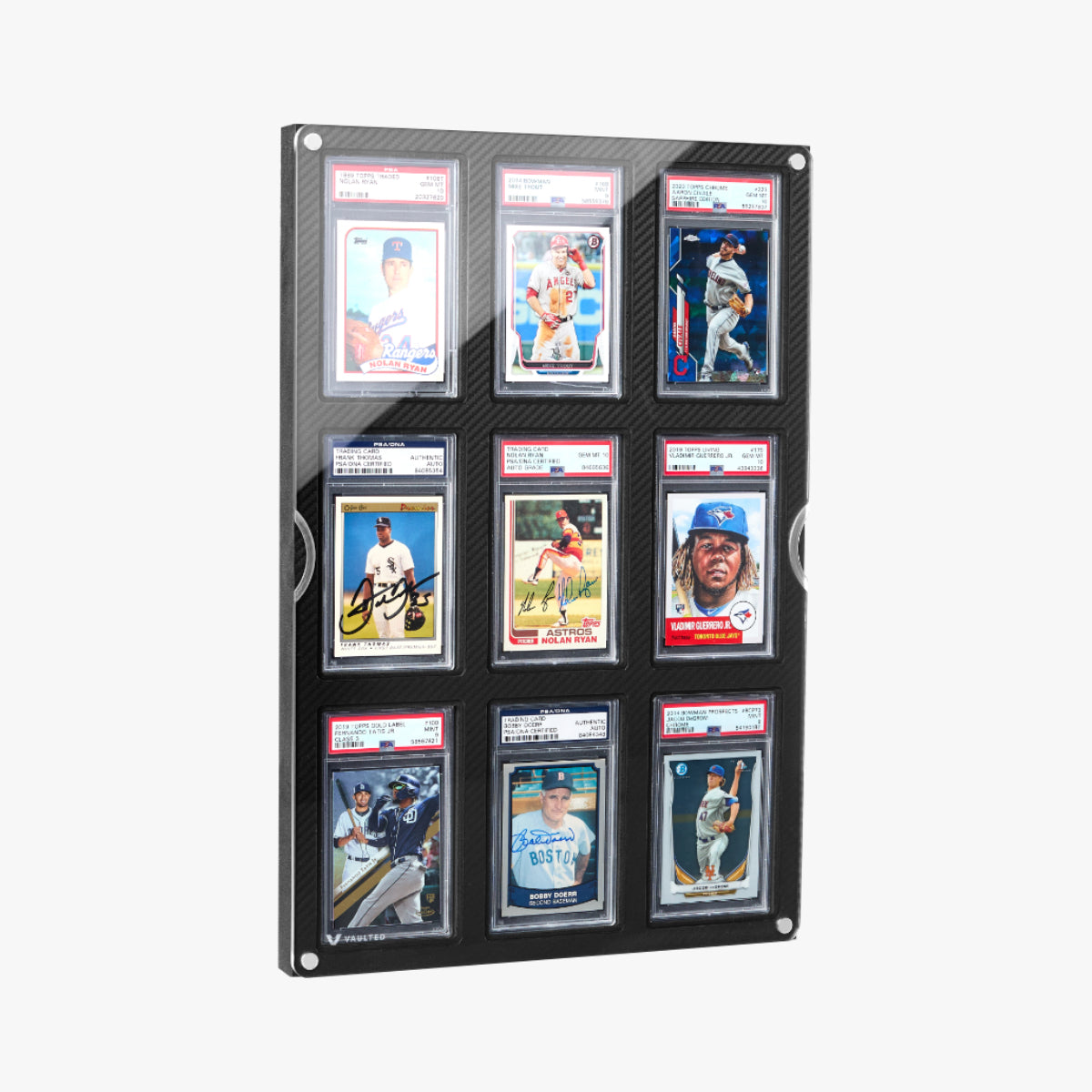
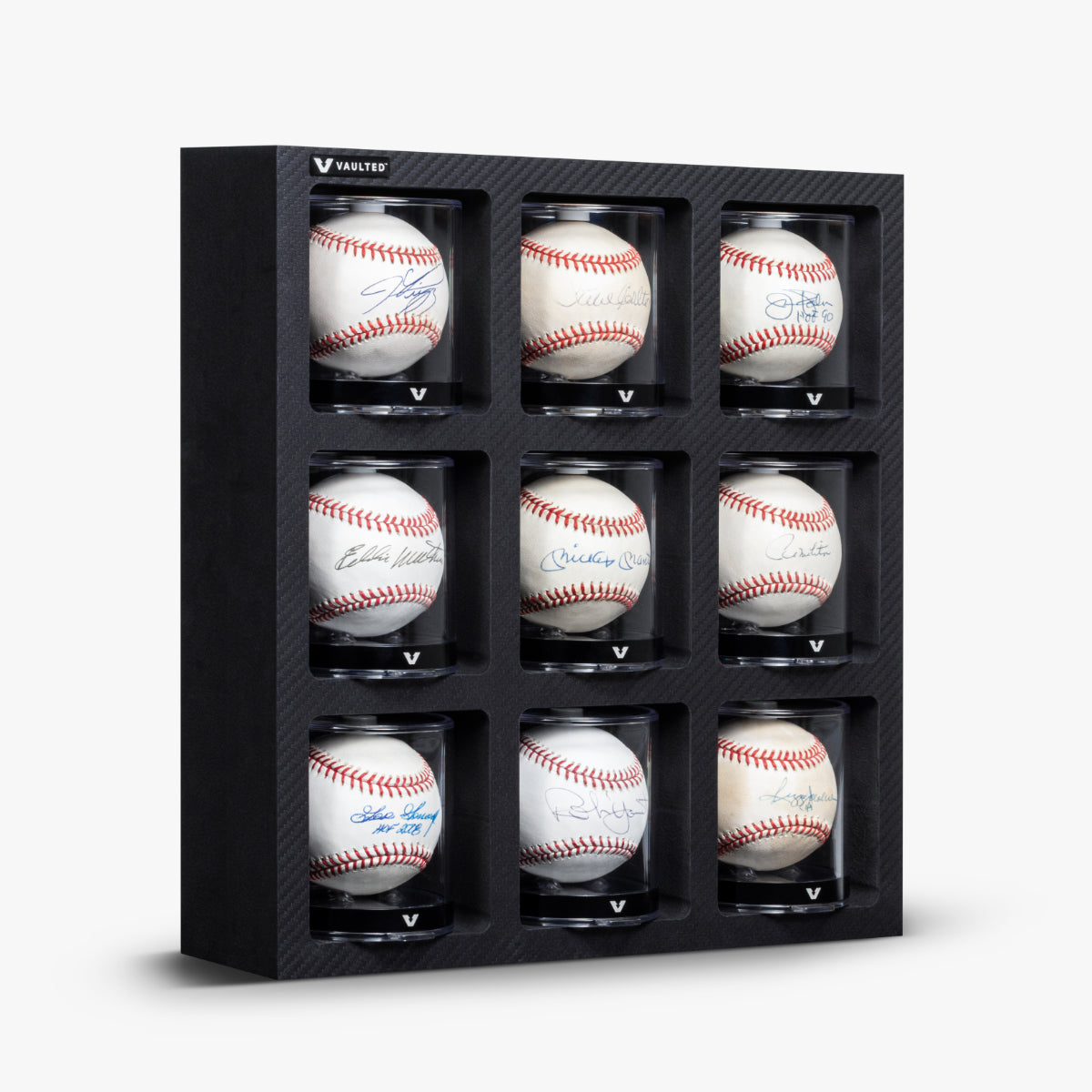
Graded slabs protect cards from handling and environmental contact, but even with a graded slab, long-term UV exposure remains a consideration for collectors who choose to display premium cards. For wall display of high-grade examples, UV-protective display solutions reduce ongoing exposure while keeping cards visible. Closed storage cases remain the safest option for cards that do not need to be on constant display.
Rotation is another strategy: displaying select pieces while storing others, then periodically rotating which cards are on view and which remain protected. This approach allows collectors to enjoy their collection without subjecting every card to years of continuous light exposure.
Frequently Asked Questions
What is Bo Jackson's most valuable rookie card?
The 1986 Topps Traded Tiffany #50T is Bo Jackson's most valuable rookie card. According to multiple auction records, a PSA 10 copy sold for $12,300 in June 2021. Only 37 PSA 10 copies exist from a limited 5,000-set print run.
How many Bo Jackson Topps Tiffany PSA 10s exist?
Thirty-seven PSA 10 copies of the 1986 Topps Traded Tiffany Bo Jackson #50T exist as of current population data. Total PSA graded population across all grades is approximately 700 copies.
Are Bo Jackson rookie cards a good investment?
Investment quality depends on the specific card and grade. Premium issues like the 1986 Topps Traded Tiffany and 1987 Leaf have shown steady appreciation driven by low PSA 10 populations (37 and 100 respectively) and sustained collector demand. Base issues like 1987 Topps, Donruss, and Fleer remain accessible and serve nostalgia demand but are unlikely to appreciate significantly due to high populations exceeding 600 PSA 10s.
What is the difference between 1986 Topps Traded and 1987 Topps Bo Jackson?
The 1986 Topps Traded Bo Jackson is an Extended Rookie Card issued in the 1986 Topps Traded update set before his 1987 base-year rookies. The 1987 Topps #170 is his true base-year rookie card from the standard Topps set. Both are legitimate rookie cards. The Tiffany parallel of the 1986 Topps Traded is significantly more valuable due to its limited 5,000-set print run and 37-copy PSA 10 population compared to 1,100 PSA 10s for the base 1986 Traded issue.
Why is the 1987 Donruss Bo Jackson worth less than other rookies?
The 1987 Donruss Bo Jackson was printed in massive quantities during the peak Junk Wax Era, and despite condition-sensitive black borders, 1,300 PSA 10 copies exist—a high population that exceeds collector demand. Supply overwhelms demand for high-population Junk Wax cards unless the player becomes a true cultural icon whose hobby standing increases materially over time.
What is the 1987 Leaf Bo Jackson rookie card?
The 1987 Leaf #35 is a Canadian-market issue distributed primarily in Canada with bilingual card backs printed in both English and French. Limited distribution outside the U.S. mainstream market created a smaller print run than Topps, Donruss, and Fleer base issues. Only 100 PSA 10 copies exist, making it the second most valuable Bo Jackson baseball rookie after the 1986 Topps Traded Tiffany.
How much is a PSA 10 Bo Jackson rookie card worth?
PSA 10 values range from low three figures for high-population base issues to low five figures for the 1986 Topps Traded Tiffany. The 1987 Leaf sits in the middle. The 1988 Topps Football rookie and premium parallels like the 1987 Topps Tiffany trade in the mid-three to four-figure range. Verify current pricing through recent eBay sold listings and auction records before making purchase or grading decisions.
Should I grade my Bo Jackson rookie cards?
Grade the 1986 Topps Traded Tiffany, 1987 Leaf, 1988 Topps Football, and any variation if condition appears Gem Mint. These cards have low enough PSA 10 populations and strong enough values to justify grading costs. Grade base 1987 issues (Topps, Donruss, Fleer) only if centering is exceptional and corners are perfect—high PSA 10 populations mean PSA 9 or lower grades do not cover submission costs on base versions.
What is Bo Jackson's football rookie card?
The 1988 Topps Football #327 is Bo Jackson's only mainstream football rookie card, issued after his 1987 NFL season with the Los Angeles Raiders. The card has a PSA 10 population of 560 copies and represents his brief but legendary NFL career—38 games, one Pro Bowl, and cultural moments that transcended statistics.
Why are Bo Jackson cards still popular?
Bo Jackson remains one of the most culturally significant athletes in sports history as one of the few players named an All-Star in two major professional sports. His 1985 Heisman Trophy, two-sport career, and Nike "Bo Knows" campaign created a legacy that transcends traditional sports statistics. Collectors who grew up during his late-1980s peak drive sustained demand for his rookie cards.
Most collectors never own a 1986 Topps Traded Tiffany. Nearly every collector measures Junk Wax Era cards against it. That's what makes it more than an expensive baseball card—it has become the standard by which a generation of collectors understands how scarcity can emerge even from an era defined by overproduction.