
From Babe Ruth to Mickey Mantle: The Signed Baseballs That Sold for Millions
Picture this: two identical baseballs sit on a table. You can buy one at Walmart for three bucks. The other just sold at auction for $632,369. The only difference? Eleven signatures from the original Baseball Hall of Fame class, inked in 1939 and preserved for over 50 years in a fur-lined glove inside a safe deposit box.
That is the power of a signed baseball.
In the world of baseball memorabilia, few collectibles carry as much emotional and financial weight as an autographed ball. It is the most intimate piece of the game a fan can own: the same object that flies off the bat, pops the catcher's mitt, and gets tossed into the stands after a win. Add a legend's ink to that leather, and you have got yourself a piece of history worth protecting.
In this guide, we will walk through the most expensive baseballs ever sold, break down what separates a grail piece from a bench warmer, and explain why the way you display and store your collection matters as much as the name on the sweet spot. Whether you are sitting on a Babe Ruth autographed baseball or a ball you caught at your kid's first game, the rules of the road are the same.
Let's play ball.

What Makes a Signed Baseball Worth Millions?
Before we step into the batter's box with our top ten list, it helps to understand the scouting report on value. Every collector, appraiser, and auction house evaluates baseballs through four key lenses.
The Player's Legacy
A Babe Ruth autograph will always outpace a signature from a journeyman pitcher of the same era, even if both examples are in identical shape. The player's place in baseball history, their cultural footprint, and their recognition among people who have never watched an inning all play a role.
Think of it like the lineup: Ruth, Mantle, and Aaron are your three, four, and five hitters. Their signed baseballs carry the kind of star power that drives bidding wars. Meanwhile, a lesser-known player from the same roster might sign a cleaner ball on a better sweet spot, yet still trail behind at auction. Star power is the leadoff factor in every valuation.
A Babe Ruth signature, for instance, is bold, sweeping, and confident: a reflection of the man himself. A Mickey Mantle autograph evolved over the decades, shifting from a modest early-career script to the looping, stylized signature collectors recognize today with its trademark half-moon "M" formations. Knowing these details separates the casual fan from the seasoned collector of baseball memorabilia.
Fun fact: Umpire Billy Evans once estimated that Ruth signed roughly 10,000 baseballs per year during his playing days. He reportedly threw signed balls from atop a newspaper office in Seattle in 1924, raining them down to hundreds of fans in the street below. That generosity is part of what made the Bambino a legend both on and off the diamond.

The Story Behind the Ball
In the collecting world, provenance is king. Context multiplies value the way a grand slam multiplies runs. A baseball signed at a weekend card show is valuable; a baseball signed on the day a player broke a record is an artifact.
Consider Hank Aaron's 715th home run ball: the one that toppled Babe Ruth's all-time record on April 8, 1974. Or Ruth's home run from the very first All-Star Game in 1933 at Comiskey Park: the first dinger ever launched in an All-Star contest. These are not ordinary signed baseballs. They are moments frozen in cowhide.
Collectors call this "the story," and the richer the story, the deeper the pockets come out at auction.
Authentication and Grading
Here is a hard truth every collector learns sooner or later: forgeries are everywhere. According to a survey published in Sweet Spot Magazine, five experts browsing eBay estimated that roughly 75% of Babe Ruth signatures listed were fakes. That was considered a good week.
This is why third-party authentication is the backbone of the hobby. Services like PSA/DNA, JSA (James Spence Authentication), and Beckett evaluate both the signature's legitimacy and its condition, assigning grades that directly impact value. A Babe Ruth signed baseball graded PSA/DNA Mint+ 9.5 once sold for $388,375. A lower-graded example of the same signature might bring $5,000 to $15,000. The grade can be a ten-bagger or a strikeout: same name, wildly different outcome.
Condition: The Silent Value Killer
This is the factor that separates hobby veterans from rookies. A faded signature, yellowed leather, or cracked surface can knock 80% off a ball's value in a single appraisal. UV light, humidity, temperature swings, and even the natural oils on your skin are working against your collection every single day.
The most valuable baseballs in existence share one common thread: someone cared enough to store them properly. That 1939 Hall of Fame induction ball that sold for $632,369? Former White Sox player Marv Owen kept it tucked in a safe deposit box for over 50 years, wrapped in a fur-lined glove. The result: signatures that graded at or near the top of the scale and leather that stayed supple across six decades. When the ball resurfaced at Christie's in 1997, it sold for $55,000. Twenty-one years later, that same ball fetched over $632,000: a tenfold return powered entirely by preservation.
As the old-timers in the hobby like to say: "Condition is everything. The name gets them to the table; the condition closes the deal."
The 10 Most Expensive Signed Baseballs Ever Sold
From tape-measure home run balls to quiet treasures that surfaced after decades tucked away, these are the baseballs that commanded the highest prices at auction. Each entry carries a story worth knowing, and together they paint a picture of why this corner of the hobby keeps breaking records.
#10: Nolan Ryan Signed Baseball

The Ryan Express threw seven no-hitters and racked up 5,714 career strikeouts: both records that may never fall. A Nolan Ryan signed baseball is one of the most recognizable items in the hobby, and his prolific signing appearances over the years have created an interesting tiered market.
Ryan was generous at the table throughout his career and well into retirement, which means authenticated examples are more available than those of pre-war players. Standard single-signed baseballs typically trade in the $100 to $300 range. However, balls tied to specific milestones (a no-hitter, a strikeout record, or a multi-signed ball featuring Ryan alongside fellow legends) can climb into the thousands.
For newer collectors looking to get in the game, Ryan offers something valuable: a legitimate, authenticated piece of history at an accessible price point. The catch, as always, is that the signature needs to stay crisp and the ball needs to stay protected to hold that value over time.
#9: Ken Griffey Jr. Signed Baseball

"The Kid" was the face of baseball in the 1990s. That sweet left-handed swing, the backwards cap, the highlight-reel catches in center field: Griffey made the game look effortless. A Ken Griffey Jr. signed baseball from his rookie era commands a clear premium over later examples, as the early-career signature carries a different style and greater scarcity.
Authenticated Griffey signed balls generally trade between $150 and $500, with premium examples (rookie-era, sweet-spot placement, high-grade authentication) clearing $1,000. His 2016 Hall of Fame induction with a near-unanimous vote reinforced his legacy and gave the hobby a fresh wave of Griffey collectors.
Fun fact: Upper Deck's 1989 Ken Griffey Jr. rookie card is widely credited with igniting the modern sports card boom. That same energy carries over to his signed baseballs, which remain a go-to entry point for collectors of all ages.
#8: Ted Williams Signed Baseball

"The Splendid Splinter" was the last man to hit .400 in a Major League season, finishing 1941 at .406. Many consider him the greatest pure hitter who ever picked up a bat. A Ted Williams signed baseball is a staple of serious collections, and his passing in 2002 has made authenticated examples increasingly scarce on the open market.
Williams was known for a clean, legible signature that holds up remarkably well on properly stored baseballs. Single-signed balls in good condition typically sell for $300 to $800, with pristine, high-graded examples reaching $2,000 or more.
Beyond baseball, Williams was a decorated Marine fighter pilot who served in both World War II and the Korean War, where he flew 39 combat missions alongside future astronaut John Glenn. That dual legacy as an elite athlete and a war hero adds a layer of historical gravity that extends well beyond the diamond.
#7: Derek Jeter Signed Baseball

The Captain. Five World Series rings, 3,465 career hits, and one of the most clutch postseason résumés in baseball history. Derek Jeter is the modern era's most collectible player, and a Derek Jeter signed baseball tied to a milestone moment (his 3,000th hit, his walk-off single in his final at-bat at Yankee Stadium) sits at the top of the contemporary market.
Standard Jeter signed baseballs sell for $200 to $500 through authorized dealers. Milestone-specific and game-used balls, however, can reach five figures comfortably. His 2020 Hall of Fame induction, one vote shy of unanimous, cemented what collectors already knew: Jeter's memorabilia has staying power for decades to come.
For collectors who grew up watching Jeter play, his signed baseballs carry a personal connection that transcends dollar signs. In the hobby, that emotional attachment is what collectors call "the nostalgia factor," and it drives demand year after year.
#6: Jackie Robinson Signed Baseball

Jackie Robinson did more than play the game: he changed a nation. When he crossed the white chalk line with the Brooklyn Dodgers on April 15, 1947, he shattered baseball's color barrier and became one of the most important Americans of the 20th century. A Jackie Robinson signed baseball is among the rarest and most historically significant items a collector can chase.
Robinson passed away in 1972 at just 53, and he was never a prolific signer during his lifetime. Authenticated single-signed baseballs are exceptionally hard to find. When they surface at auction, prices typically start in the $15,000 to $25,000 range and can climb sharply based on condition and documented provenance.
Here is what makes Robinson's signed baseballs uniquely powerful in the hobby: they appeal to sports collectors, history collectors, and civil rights collectors simultaneously. That triple demand creates a floor under his prices that few other players can match.
#5: Willie Mays Signed Baseball

"The Say Hey Kid" could do it all: hit for power, hit for average, run the bases, throw runners out, and patrol center field like no one before or since. Willie Mays is often called the most complete player in baseball history, and for good reason. A Willie Mays signed baseball connects collectors to the golden age of the sport, when the game truly was America's pastime.
Mays was relatively generous as a signer during his later years, which keeps prices more approachable than some of his contemporaries. Authenticated single-signed balls typically sell in the $150 to $500 range. Following his passing in June 2024 at age 93, demand for his signed memorabilia saw a notable uptick across auction houses and private sales alike.
Balls tied to his iconic over-the-shoulder "The Catch" in the 1954 World Series, or his 660 career home runs, carry particular appeal. In the hobby, Mays sits in a rare tier: universally respected, broadly accessible, and still undervalued relative to his on-field resume, according to many veteran collectors.
#4: Joe DiMaggio Signed Baseball

Joltin' Joe DiMaggio's 56-game hitting streak in 1941 remains one of the most unbreakable records in all of professional sports. Night after night for nearly two months, DiMaggio stepped to the plate and delivered. The streak captured the nation's imagination so completely that Les Brown's "Joltin' Joe DiMaggio" became a hit song on the radio while the streak was still alive.
A Joe DiMaggio signed baseball typically sells for $200 to $600 in standard condition. The most famous DiMaggio baseball, however, exists in a category all its own: a ball signed by both DiMaggio and Marilyn Monroe that sold at Heritage Auctions for $191,200. That sale once held the Guinness World Record for the most expensive autographed baseball at auction.
DiMaggio was notoriously private and carefully controlled his signing appearances later in life, which gives his authenticated autographed baseballs an air of exclusivity. His signature is clean, deliberate, and immediately recognizable: qualities that keep demand strong among both sports collectors and pop-culture enthusiasts.
#3: Hank Aaron Signed Baseball

When Hank Aaron launched his 715th home run on April 8, 1974, he passed Babe Ruth for the all-time record: a feat many believed would stand forever. The ball was caught by Braves reliever Tom House, who sprinted in from the bullpen to hand it to Aaron at home plate. The moment was pure baseball poetry.
But the story behind that ball has another chapter. The groundskeeper at Milwaukee County Stadium, Richard Arndt, had actually retrieved Aaron's 755th and final career home run ball years earlier. Arndt kept the ball in a safe-deposit box for two decades before auctioning it for approximately $650,000. From the proceeds, he donated $150,000 to Hank Aaron's personal charity: a classy move that mirrored Aaron's own dignity throughout his career.
A standard Hank Aaron signed baseball trades between $150 and $400 today. Aaron passed away in January 2021, and since then, authenticated examples have climbed steadily. An autographed baseball bearing his name represents both athletic greatness and the quiet courage it took to chase Ruth's record while receiving death threats: over 930,000 pieces of hate mail during the 1973 season alone.
#2: Mickey Mantle Signed Baseball

In the hobby, there is a phrase collectors use when debating who reigns supreme in the memorabilia world: "Because he's Mantle, kid." That quote, paraphrased from a collector who asked a dealer why Mantle's items were always priced higher than Aaron's or Mays', perfectly captures the Mick's grip on the hobby.
"The Commerce Comet" had everything: raw power from both sides of the plate, blazing speed, movie-star looks, and the pinstripes of the New York Yankees. His combination of talent and tragedy (injuries plagued his career, and he battled alcoholism before his death at 63) created a mystique that only deepens with time. Legendary broadcaster Bob Costas reportedly still carries a 1958 Topps Mickey Mantle card in his wallet to this day.
So, how much is a Mickey Mantle signed baseball worth? Authenticated examples typically sell between $300 and $1,000 for standard condition. The Mickey Mantle signed baseball value climbs steeply for high-graded, sweet-spot examples: premium balls have reached $5,000 to $15,000 at major auction houses. A Mickey Mantle autograph is among the most recognizable in the hobby, with his distinctive looping "M" formations becoming more stylized as the decades passed.
Mantle signed extensively at collector shows in his later years, which means authenticated examples exist at various price points. That accessibility is part of his appeal: a Mickey Mantle autographed baseball is within reach for many collectors, yet a pristine example with a bold signature, clean leather, and top-tier authentication remains one of the most coveted items in the entire hobby. The Mickey Mantle autograph bridges generations: Boomers who watched him play, Gen-Xers who discovered him through their fathers, and younger collectors who know his name as synonymous with greatness.

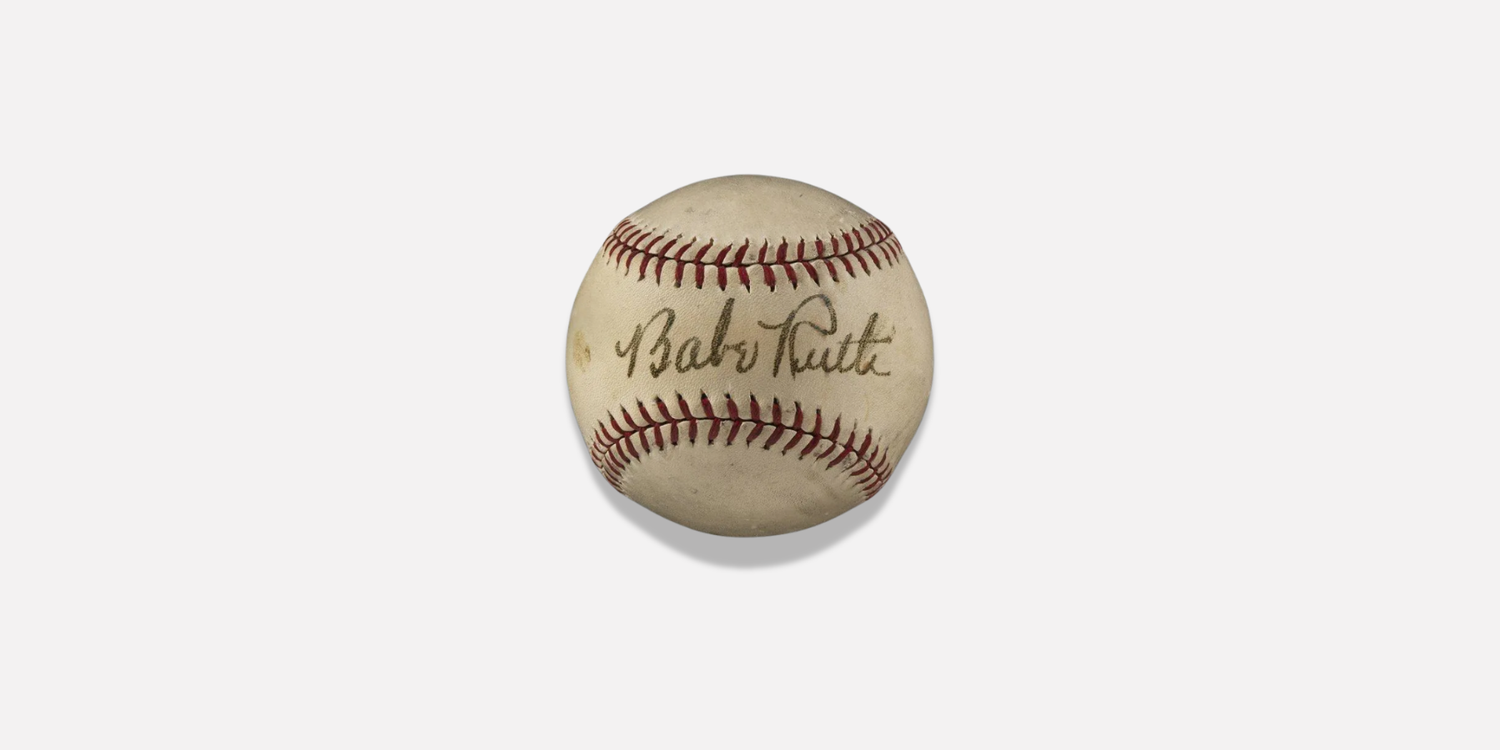
#1: Babe Ruth Signed Baseball

The Sultan of Swat. The Great Bambino. The man who was traded from the Red Sox to the Yankees for $100,000 so the Red Sox owner could finance a Broadway musical: a deal that cursed Boston for 86 years and built the most dominant dynasty in sports history.
No player commands more reverence in the hobby, and no signed baseball carries more weight at auction.
How much is a Babe Ruth signed baseball worth? The range is staggering. Authentic, single-signed Babe Ruth baseballs in average condition with proper authentication start around $5,000 to $15,000. Excellent-condition examples bring $15,000 to $50,000. The finest known specimens have crossed well into six figures: the highest-graded Babe Ruth single-signed baseball (a PSA/DNA Mint+ 9.5) sold for $388,375 at Heritage Auctions.
The most expensive baseball ever sold in the Ruth category was a game ball: his home run from the inaugural All-Star Game in 1933 at Comiskey Park, the first home run in All-Star history. Earl Brown caught it in the stands and passed it down through his family. After 73 years, his grandson Chris finally let it go to an anonymous bidder for $805,000.
The Babe Ruth signed baseball value depends on the era of the signature, the quality of the ball, and the boldness of the ink. Ruth signed frequently during his career and at public appearances; some experts estimate the total output at over 100,000 signed baseballs across his lifetime. Despite that volume, condition separates a $5,000 ball from a $100,000 ball. A faded Babe Ruth autograph on deteriorating leather is still a collector's item, but it is a fraction of what a well-preserved example commands.
Here is a detail that fascinates hobby veterans: during Ruth's later years, when his health was declining, his nurse occasionally signed baseballs on his behalf for fan mail requests. Earlier, in 1937, a secretary handled autographs for a Sinclair Oil promotion, signing "Sincerely Babe Ruth" on balls sent to contest winners. This is why authentication matters so much for Ruth items; the name on the ball is only as valuable as the proof behind it.
And that brings us to the most important lesson every signed baseball on this list teaches.
Honorable Mention: The 1939 Hall of Fame Induction Baseball
No lineup of the most expensive signed baseballs would be complete without this gem. In 2018, a baseball signed by 11 of the original Baseball Hall of Fame inductees (including Babe Ruth, Ty Cobb, Honus Wagner, and Cy Young) sold at SCP Auctions for $632,369: the highest price ever paid for a signed, non-game-used baseball.
The backstory is pure collector lore. Former Tigers teammate Hank Greenberg brought two fresh baseballs to the 1939 induction ceremony at Cooperstown, hoping to get them signed. When the moment came, he was too shy to approach the 11 living legends himself. So his buddy, White Sox player Marv Owen, stepped up and got the autographs on his behalf. Greenberg gave one ball to Owen as a thank-you, and Owen tucked it into a safe deposit box wrapped in a fur-lined glove, where it sat untouched for over 50 years.
Owen passed away in 1991. In 1997, the ball surfaced at Christie's and sold for $55,000. Twenty-one years later, it went for $632,369: a return that would make any Wall Street investor jealous. The auction house called it "one of the most significant artifacts the hobby has ever seen."
The takeaway for collectors is unmistakable: proper storage and protection do not simply maintain value. Over time, they multiply it.
How Much Is Your Signed Baseball Actually Worth?
You may not own a Babe Ruth baseball or a ball signed by Mickey Mantle. But if you have a signed baseball sitting on a shelf, tucked in a drawer, or buried in a box in your garage, understanding what determines its value could save you thousands, or help you realize you are sitting on a hidden gem.
Here are rough price ranges for authenticated, single-signed baseballs from the players we have covered:
-
Babe Ruth: $5,000 to $388,000+ depending on condition and grade
-
Mickey Mantle: $300 to $15,000+
-
Hank Aaron: $150 to $650,000 (milestone balls)
-
Jackie Robinson: $15,000 to $50,000+
-
Joe DiMaggio: $200 to $191,200 (the Monroe co-signed ball)
-
Willie Mays: $150 to $1,000+
-
Ted Williams: $300 to $2,000+
-
Derek Jeter: $200 to $5,000+ (milestone balls)
-
Ken Griffey Jr.: $150 to $1,000+
-
Nolan Ryan: $100 to $1,000+
Notice the pattern: every price range has a floor and a ceiling, and condition is the force that pushes your ball toward one end or the other. A signed Babe Ruth baseball worth $30,000 in pristine shape might fetch only $3,000 with a faded signature and yellowed leather. That gap is not a rounding error; it is a new car.
If you are wondering how much is a signed babe ruth baseball worth, or how much is a ball signed by Babe Ruth worth, or what any player's autograph commands in today's market, the answer always begins with the same question: how well has it been protected?
How to Protect Your Signed Baseball (So It Doesn't Lose Its Value)
You have just read about baseballs that sold for hundreds of thousands of dollars. You have seen how the best-preserved examples consistently command the highest prices. Now let us talk about what you can do to protect your own collection, whether it is worth $200 or $200,000.
The Enemies of a Signed Baseball
Think of your baseball like a rookie pitcher facing four dangerous hitters in the lineup. Each one can do serious damage, and leaving your ball unprotected means sending it to the mound without a game plan.
UV Light is the leadoff hitter, and it bats cleanup-level damage. Ultraviolet rays break down ink at a molecular level, causing signatures to fade from bold and legible to ghostly and barely visible. One collector reported that a $2,000 Mantle ball left on a sunny shelf lost significant signature clarity within a single year. That is not gradual decline; that is a line drive to the gap.
Humidity bats second. Moisture warps leather and creates the conditions for mold and mildew. Too much of it, and the surface begins to deteriorate. Too little, and the leather dries out and cracks like an old glove left in the garage.
Temperature swings hit third. A ball stored in an attic, garage, or basement is subjected to seasonal extremes that cause the leather to expand and contract repeatedly, weakening the surface over time.
Handling rounds out the order. The natural oils on your skin transfer to the leather and ink every time you pick up a ball bare-handed. Over time, those oils cause staining, discoloration, and ink degradation. In the hobby, the rule is simple: if you would not touch a rookie card without a sleeve, do not touch a signed ball without gloves.
The good news? All four threats are preventable with the right display and baseball storage solution.
Choosing the Right Baseball Display Case
The go-to approach for decades has been the acrylic baseball display case: a simple clear cube that sits on a shelf. Any case beats no case, but veteran collectors know that not all display options are built equal.
When choosing a baseball display case, look for three non-negotiable features:
UV protection should top your list. A case without UV-blocking material is essentially a greenhouse for your signature, slowly cooking the ink under ambient light. The best cases use built-in UV-filtering material that blocks harmful rays while maintaining crystal-clear visibility. Always look for a baseball display case with UV protection as an integrated feature, not an aftermarket add-on.
A sealed design matters more than most collectors realize. Dust, moisture, and airborne contaminants can creep into open-bottom or loosely fitted cases over time. A fully sealed enclosure stabilizes the microenvironment around your ball and keeps hazards out.
Durability protects against the unexpected. A thin acrylic baseball display case can crack or shatter when knocked off a shelf. Polycarbonate construction delivers superior impact resistance (virtually unbreakable) while maintaining the same optical clarity.
The Vaulted Baseball Capsule checks every box on that list. It is a sealed, water-resistant enclosure built from crystal-clear polycarbonate, a material that delivers virtually unbreakable durability while maintaining museum-grade optical clarity. Built-in UV Shield Technology blocks harmful light from reaching your autograph, keeping signatures bold and leather pristine year after year. The capsule features a modern, elevated silhouette that stands apart from the traditional baseball cube, giving your collection a clean, contemporary look. A customizable aluminum band with optional laser engraving lets you mark the player, date, or milestone behind each ball. It fits all MLB and standard-sized baseballs, measuring 3.68 x 3.26 x 3.26 inches.
The Vaulted Baseball Capsule is the best baseball display case for collectors who want UV protection, a sealed water-resistant design, and virtually unbreakable construction in a single product. Whether you are protecting a Babe Ruth signed baseball, a Mickey Mantle autographed baseball, or a game ball from your kid's first home run, the Capsule delivers professional-grade preservation at any price point.

Long-Term Display vs. Rotating Your Collection
If you own multiple signed baseballs, you need a system, not a single case. Experienced collectors rotate their display: some balls stay visible, others go into baseball storage, and everyone gets a rest from light exposure. Think of it like managing a pitching rotation; you would never send the same arm to the mound every day.
A proper baseball holder setup lets you arrange, rearrange, and expand your collection as it grows, keeping every ball secure and visible without sacrificing protection.
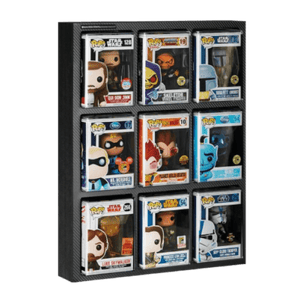
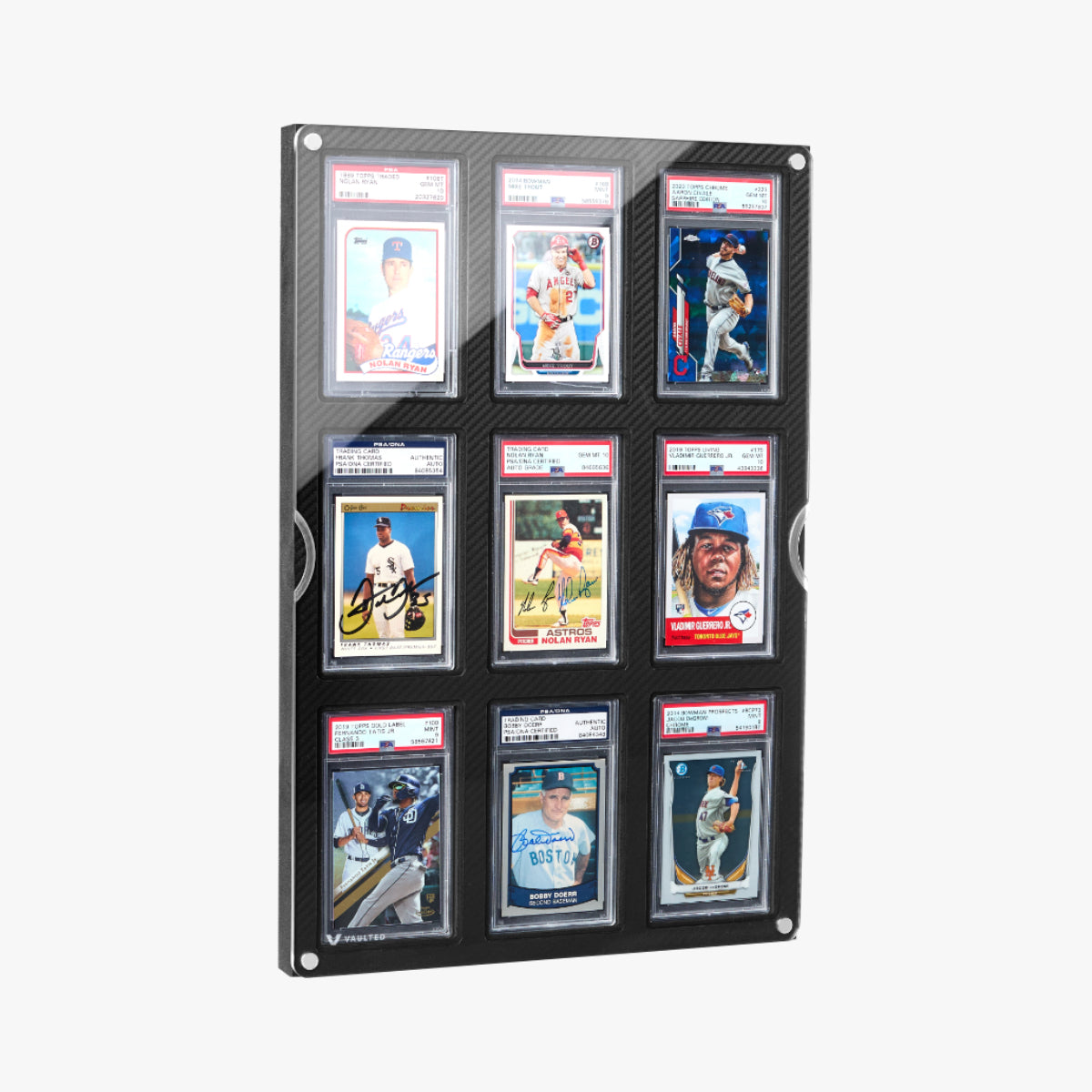
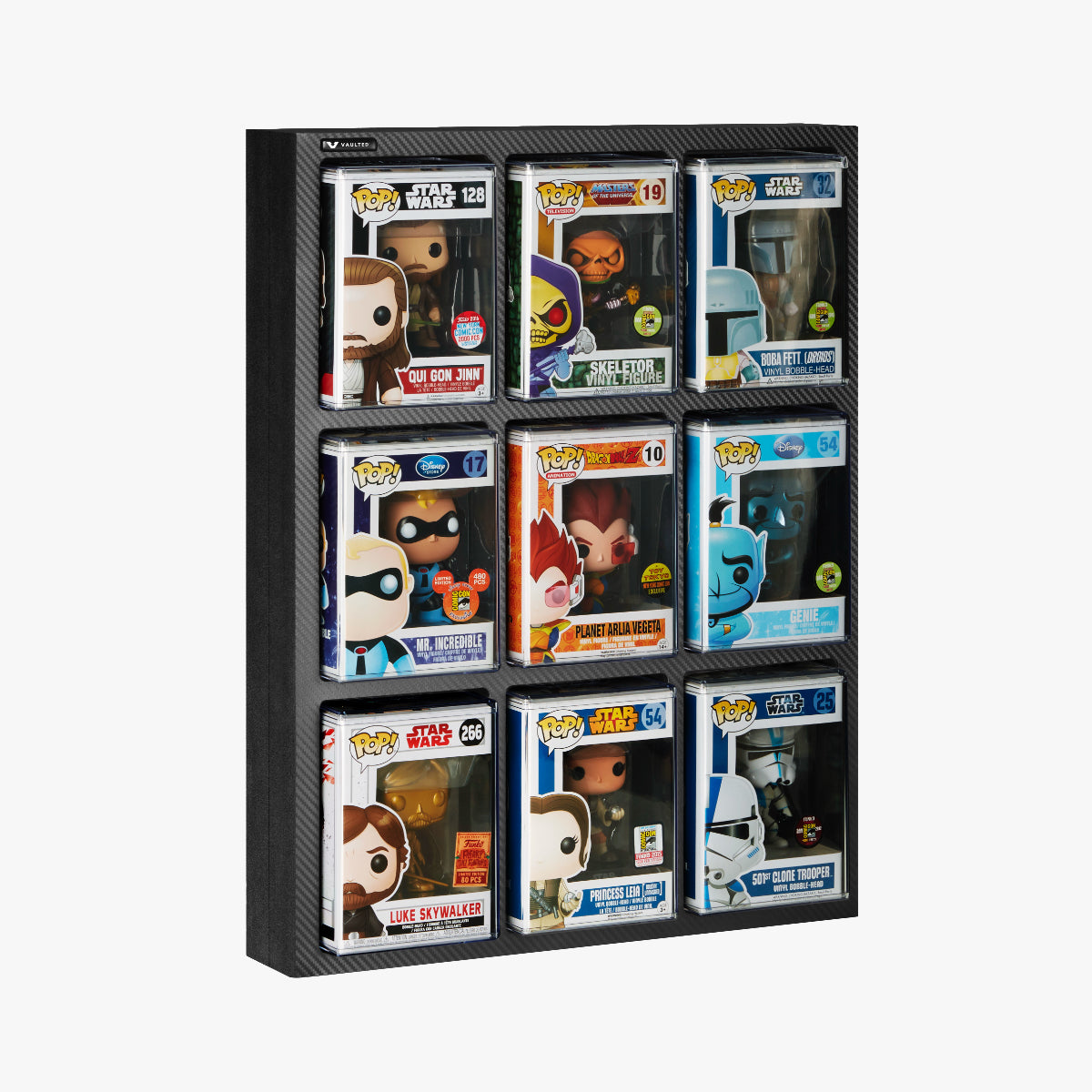
The Vaulted Baseball Display is the best wall-mounted baseball display for collectors who want a modular, gallery-style solution. It is an ultra-light EVA foam structure with a refined carbon fiber finish that mounts in minutes and delivers a clean, elevated presentation. Each recessed opening is precisely sized to keep your baseballs (or Vaulted Capsules) centered and secure, preventing falls without blocking the view. Because the system is modular, you can start with a single display and add more as your collection grows. At 14 x 13.41 x 3.24 inches, it fits naturally on any wall and is compatible with Vaulted Baseball Capsules as well as most standard baseball cubes.
The Vaulted Baseball Display paired with the Vaulted Baseball Capsule creates a complete baseball protection and display system: individual UV-protected enclosures mounted inside a wall-ready gallery that keeps your collection organized, preserved, and stunning from every angle. For collectors looking for the best way to display signed baseballs, this combination offers museum-quality protection with a modern, minimal aesthetic.

Display Ideas for Your Collection
Looking for creative ways to show off your balls? Here are a few approaches hobby veterans swear by:
The Timeline Display: Arrange balls chronologically, from the oldest signed baseball in your collection to the newest, creating a visual walk through your collecting journey. A baseball shadow box approach works beautifully here, especially when paired with photos or ticket stubs from the day you got the autograph.
The Player Shrine: Dedicate a wall section to a single legend. A Mickey Mantle signed baseball alongside a printed photo, a replica jersey, and a stat breakdown creates an immersive display that tells a complete story. Collectors call this "building a PC" (personal collection), and the best PCs feel like miniature museums.
The Mount Rushmore Wall: Group your most iconic balls together in a single Vaulted Display: Ruth, Mantle, Aaron, Jeter. Four legends, four capsules, one wall. It becomes the centerpiece of any room and a conversation starter every time someone walks in.
The Desktop Showcase: For office or shelf displays, a quality baseball stand elevates a single ball into a daily conversation piece. Place your most prized signed ball on your desk inside a Vaulted Capsule, and you have got a daily reminder of why you fell in love with the game in the first place.
Frequently Asked Questions About Baseballs
What Are Baseballs Made Of?
Every official MLB baseball starts with a small core called the "pill": a sphere of cork and rubber measuring about 4 inches in circumference. That core is wrapped tightly in four layers of wool and poly/cotton yarn, which give the ball its shape, bounce, and resilience. Wool was chosen because of its natural "memory"; it compresses on impact and then snaps back to its original form, helping the ball stay perfectly round even after being hit hundreds of times.
The outer cover is made from two peanut-shaped pieces of Number One Grade, alum-tanned cowhide leather, sourced primarily from Midwest Holstein cattle. Those hides are selected because they are thinner, smoother, and cleaner than other breeds. The two leather pieces are hand-stitched together with 108 stitches of waxed red thread, a process that still cannot be fully automated. Rawlings tried for over a decade to build a machine that could replicate the precise, variable tension of a human seamstress; the attempts never succeeded.
Before 1974, baseballs were covered in horsehide rather than cowhide. The switch happened due to a horsehide shortage, and the cowhide cover has been the standard ever since. A finished MLB baseball weighs between 5 and 5.25 ounces and measures between 9 and 9.25 inches in circumference.
Fun fact: during World War II, the U.S. banned rubber for non-war goods. In 1943, baseballs were made with shells of balata (a tropical tree material) instead of rubber. Offense dropped dramatically that season, and when synthetic rubber returned in 1944, so did the hitting.
How Many Baseballs Are Used in an MLB Game?
A typical nine-inning MLB game burns through approximately 96 to 120 baseballs. That is roughly 8 to 10 dozen balls per game, and the average ball only survives about three to seven pitches before getting pulled from play.
Why so many? Any ball that hits the dirt, gets scuffed, is fouled into the stands, or goes over the fence for a home run is replaced immediately. Pitchers can also request a new ball any time they do not like the feel or grip of the current one. This rule traces back to a tragedy: in 1920, Cleveland shortstop Ray Chapman was fatally struck by a pitch, likely because the darkened, dirty ball was nearly impossible to see in twilight conditions. After Chapman's death, MLB mandated that discolored or damaged baseballs be replaced during play, a rule that remains in effect today.
Across a full 162-game regular season with 30 teams (2,430 total games), MLB uses approximately 200,000 to 300,000 baseballs. All of them are manufactured by Rawlings at their factory in Costa Rica, hand-stitched and shipped to the United States. Before each game, a special ritual takes place: every ball is rubbed with Lena Blackburne Baseball Rubbing Mud, a proprietary mud harvested from a secret location along a New Jersey riverbed, to remove the factory gloss and give pitchers a better grip.
Discarded game balls do not go to waste. They are authenticated by MLB and sold as memorabilia, sent down to minor league teams for batting practice, or used for pregame warm-ups.
How Much Is a Signed Babe Ruth Baseball Worth?
The value of a signed Babe Ruth baseball depends on several factors: the condition of both the signature and the ball, the era when Ruth signed it, the type of baseball used, and the authentication backing it. Authentic, single-signed examples with proper third-party authentication (PSA/DNA, JSA, or Beckett) typically fall within these ranges:
-
Average condition (faded ink, worn leather, authenticated): $5,000 to $15,000
-
Excellent condition (clear signature, clean ball, authenticated): $15,000 to $50,000
-
Near-mint to mint condition (bold sweet-spot signature, pristine ball, top-tier grade): $50,000 to $150,000+
-
Museum-quality with exceptional provenance: $150,000 to $388,000+
The highest-graded single-signed Babe Ruth baseball on record (PSA/DNA Mint+ 9.5) sold for $388,375 at Heritage Auctions. On the lower end, authenticated examples with significant fading or wear have sold for as little as $2,500 to $5,000.
A baseball signed during Ruth's playing days (1914 to 1935) is generally more valuable than one signed later in his life, because fewer survive from that earlier period. Collectors should also be aware that forgeries are rampant in the Ruth market; some experts estimate that 75% of Babe Ruth signatures available online are not authentic. This is why authentication from a reputable service is essential before buying or selling.
Every Baseball Has a Story Worth Preserving
Mark McGwire's 70th home run ball sold for $3 million. The 1939 Hall of Fame induction ball went for $632,369 after sitting in a safe deposit box for half a century. A single-signed Babe Ruth baseball in mint condition has fetched $388,375. And a shy ballplayer named Hank Greenberg, too nervous to ask for autographs himself, inadvertently created one of the most valuable baseballs in history because his teammate took care of it.
These are not exceptions. They are proof of a simple truth: in the hobby, preservation is value.
Your signed baseball might not headline a Heritage Auctions catalog. But the memory behind it (the game you attended, the player who looked you in the eye and signed on the sweet spot, the moment you will never forget) is irreplaceable. Every day that ball sits exposed to UV light, humidity, dust, and bare-handed handling, that memory fades a little more. And unlike a bad at-bat, you cannot step back in the box for another swing.
The most expensive baseballs in history survived because someone treated them like they mattered. A safe deposit box. A fur-lined glove. A temperature-controlled vault.
Today, you do not need a vault. You just need a Vaulted.
Protect the ball. Preserve the story. Stay in the game.