



Trading Card Market: Pokémon vs. Sports Cards for Long-Term Value
I’ve been in this hobby long enough to remember when a PSA 10 Charizard could be bought for under a grand and when people laughed at the idea that Pokémon cards value would ever rival vintage sports. Fast forward to today, and we’re living in a trading card market where a fictional fire-breathing lizard has gone toe-to-toe with the most expensive baseball cards ever printed.
So the real question for experienced collectors isn’t “Which is hotter right now?”
It’s: Which market holds up when the hype fades?
Let’s talk honestly.
Overview of the Trading Card Market
The modern trading card market has moved well beyond its niche origins. What was once driven primarily by hobbyists is now supported by institutional capital, global liquidity, and data transparency, with population reports and price histories tracked as closely as financial assets. Cards are no longer evaluated solely on nostalgia—they’re analyzed through supply, demand, and long-term performance.
From a market perspective, trading cards now span multiple segments. The global TCG market is valued at approximately $7.51 billion in 2025, growing at a steady 7.9% CAGR, while the sports card market is significantly larger at nearly $13 billion in 2024. That scale, however, comes with fragmentation, as sports card value is spread across leagues, eras, and individual player outcomes rather than concentrated around a single franchise.
For experienced collectors, size alone is not the deciding factor. What ultimately matters is durability—how consistently demand holds up, how easily a card can be sold, and whether it retains relevance decades from now. Liquidity, demand curves, and emotional attachment are not secondary considerations in the trading card market; they are the foundation of long-term value.
What Drives Long-Term Value in the Trading Card Market
Before Pokémon vs. Sports, let’s talk fundamentals—because the card value rules are the same everywhere.
Rarity, Condition, and Grading
True scarcity beats manufactured scarcity every time.
-
Vintage sports cards like the rarest baseball card (T206 Honus Wagner) survive because supply is fixed
-
Pokémon’s elite tier—1st Edition Base, Trophy cards—operate the same way
PSA graded 15.3 million items in 2024 alone, and that’s where the “junk slab” risk creeps in. When pop counts hit 10,000+ PSA 10s, scarcity becomes theoretical.
Cultural Relevance and Nostalgia
This is Pokémon’s secret weapon.
Pokémon isn’t just a TCG—it’s the #1 media franchise in history, with over $115B in lifetime revenue. That creates a utility floor sports cards don’t have.
Charizard can’t tear an ACL.
Market Cycles and Timing
Every collector learns this eventually:
- Buy blue-chip in boredom
- Sell hype at peak euphoria
Right now, we’re seeing a resurgence of vintage Pokémon and a cooling of ultra-modern sports speculation.
The Most Expensive Sports Cards

Sports built the foundation of the trading card market, and its icons still anchor it.
Some benchmarks:
- T206 Honus Wagner — widely considered one the most expensive baseball card, the rarest baseball card, and often the most expensive sports card ever sold
- 1952 Topps Mickey Mantle — the cornerstone of most valuable baseball cards lists
- High-end modern outliers like LeBron James Exquisite RPAs among the most expensive basketball cards
- Elite football cards competing for the most expensive football card title
These aren’t just expensive baseball cards — they’re cultural artifacts. Their value comes from: survival rates, historical importance and irreplaceable supply
The Most Expensive Pokémon Cards

Pokémon reached this tier faster — and surprised a lot of skeptics.
Top-tier examples include:
-
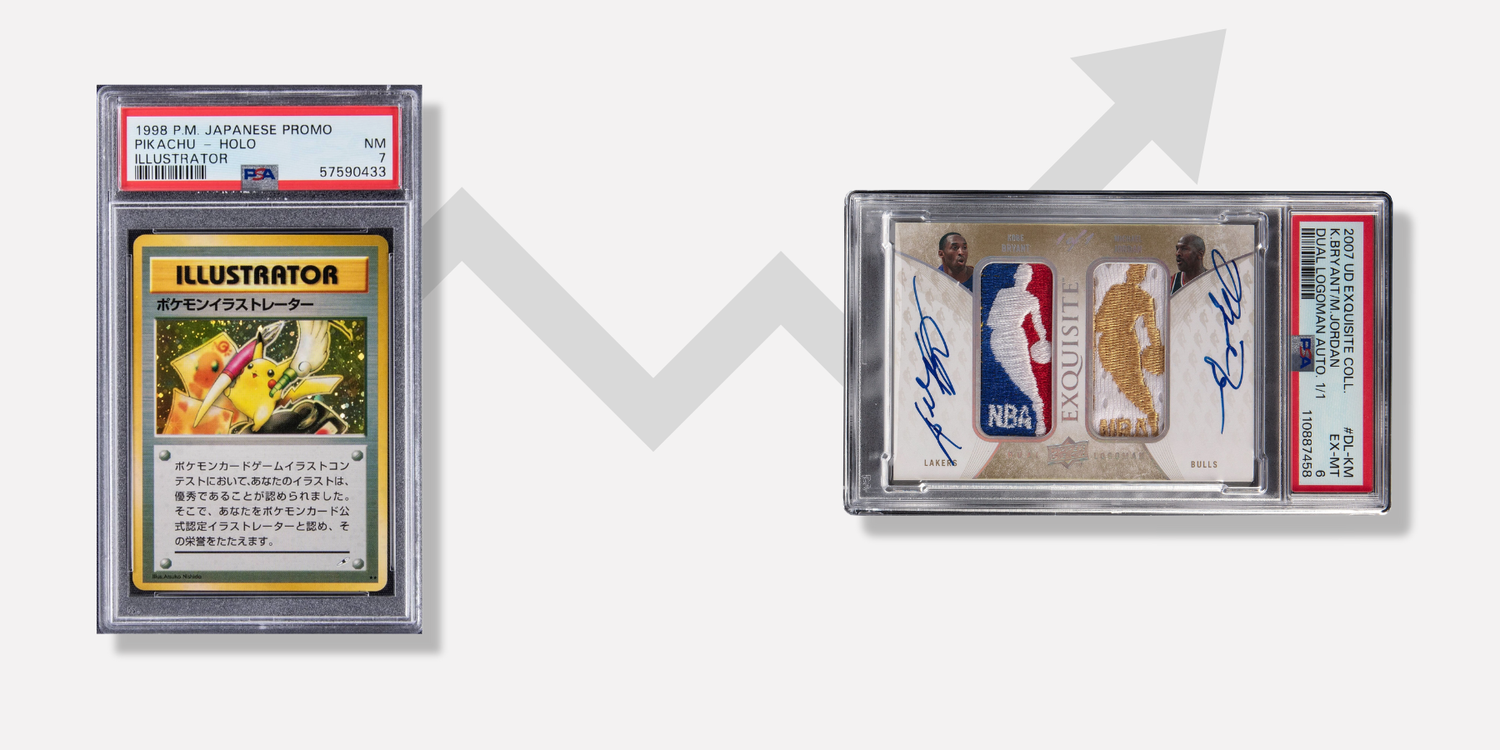
Pikachu Illustrator, widely recognized as the most expensive Pokémon card
-
1st Edition Shadowless Charizard, a benchmark for highest value Pokémon cards
-
Trophy cards (No. 1–3 Trainer), which define the rarest Pokémon card category
These cards reshaped how collectors think about Pokémon cards value — proving they belong in the same conversation as the most expensive sports card sales.
Pokémon Cards in the Trading Card Market
Pokémon cards value has fully matured within the trading card market, moving far beyond its origins as a children’s game. Backed by the world’s most valuable media franchise, Pokémon benefits from an unusual mix of global brand power, active gameplay utility, and cross-generational nostalgia—three forces that create consistent, durable demand.
While each new Pokémon set generates short-term excitement, long-term value has reliably concentrated in established icons rather than ultra-modern chase cards. According to Card Ladder data, Pokémon has delivered approximately 3,821% returns since 2004, significantly outperforming the S&P 500. As a result, serious Pokémon cards value discussions now focus less on speculation and more on preservation, recognition, and liquidity.
The primary structural risk is supply. The Pokémon Company prints an estimated 9.7–10.2 billion cards annually, and many modern hits already carry five-figure PSA 10 populations. This “junk slab” risk makes tools like a Pokémon card price checker, a trusted TCG price guide, and population reports essential when evaluating long-term tcg card value. Not every card labeled the “best Pokémon card” in the current cycle will remain relevant over time.
Sports Cards in the Trading Card Market
Sports cards remain the foundation of the trading card market, with more than a century of historical validation. The most valuable baseball cards and rare baseball cards earned their status through time, scarcity, and cultural significance—often tied to Hall of Fame careers and defining moments that shaped entire eras of sport.
That same connection to real-world performance introduces volatility. Modern sports cards worth money are inherently exposed to injuries, role changes, and shifting narratives. A single season-ending injury can materially impact value, making sports cards higher-risk, higher-reward assets by design. This performance dependency defines the category—and it’s a risk profile that Pokémon, anchored to fictional characters and global IP, does not share.
Pokémon vs. Sports Cards — Trading Card Market Comparison

Any meaningful comparison in the trading card market has to begin with historical performance. Sports cards bring more than a century of precedent, with long-term value established through generational icons like Honus Wagner and Mickey Mantle—names that anchor the most valuable baseball cards and define the upper tier of the most expensive sports card sales. That depth of history provides confidence, but it also means growth has been incremental and uneven across eras.
Pokémon, by contrast, achieved blue-chip validation in roughly 25 years. In that time, it established a narrow but highly reliable tier of cards—1st Edition Base Set, trophy cards, and franchise-defining characters—that behave similarly to vintage sports assets. According to Card Ladder data, Pokémon has delivered a 3,821% return since 2004, demonstrating that Pokémon cards value has already matured into a legitimate long-term segment of the trading card market. Both categories work, but Pokémon reached maturity far faster.
Volatility is where the markets truly diverge.
- Sports cards remain high-risk, high-reward. Modern sports cards worth money are directly tied to: Player performance, injury risk and media narratives and career longevity. A single season-ending injury or role change can materially impact card value overnight.
- Pokémon blue-chip cards operate with far lower volatility. Their value is not dependent on performance cycles or external variables, making them slower, less exciting, and structurally more stable. That predictability is precisely why the highest value Pokémon cards appeal to collectors focused on long-term preservation rather than speculation.
- Liquidity ultimately determines which cards hold up under real-world pressure. A simple question highlights the difference:
How fast can a $5,000 card realistically be sold?
-
A PSA 10 Charizard—one of the most recognizable rare Pokémon cards—can often move within minutes across global marketplaces.
-
A mid-tier modern sports card may depend entirely on timing, recent performance, and buyer sentiment. If momentum stalls, liquidity can disappear.
This dynamic is supported by broader retail data. eBay and Walmart reported approximately 200% growth in trading card sales from 2024 to 2025, confirming that liquidity exists at scale—but primarily for cards with universal recognition and established demand. In practice, the trading card market consistently rewards icons over speculation.
Trading Card Companies and Supply Control
Supply control is a key structural difference within the trading card market. Sports cards operate under a fragmented licensing model, historically led by Panini and Topps, with Fanatics now consolidating control through exclusive league agreements. This environment encourages innovation but also increases reliance on serial numbering, parallels, and short-print variations to manufacture scarcity.
Pokémon follows a centralized model. The Pokémon Company retains tight control over its intellectual property and card production, which has historically supported brand consistency and long-term demand. While modern Pokémon faces overproduction risk, scarcity at the high end—vintage and trophy cards—remains fixed due to limited historical supply.
In practice, sports cards tend to rely on manufactured rarity, while Pokémon’s strongest value has come from organic scarcity created over time. That distinction plays a meaningful role in long-term value stability across the trading card market.
Is the Trading Card Market a Good Long-Term Investment?
That depends on how “investment” is defined. In the trading card market, long-term performance is driven less by short-term price spikes and more by durability—consistent demand, cultural relevance, and proven liquidity across market cycles. Unlike traditional assets, cards sit at the intersection of collectibles and alternative investments, where fundamentals such as scarcity, brand strength, and buyer depth matter as much as historical returns.
Reliable market data supports this distinction. While segments of the market have delivered outsized gains, long-term value has concentrated in a narrow tier of established, highly recognizable cards rather than broadly across new releases or speculative assets. As a result, the trading card market tends to reward collectors who prioritize preservation of value and liquidity over volatility-driven upside.
Pros and Cons of Trading Card Investing
| Pros | Cons |
|---|---|
| Tangible assets | Storage |
| Global liquidity | Authentication |
| Emotional upside | Market cycles |
| Junk slab risk |
Who the Trading Card Market Is Best Suited For
- Pokémon: collectors who want stability + nostalgia
- Sports: collectors who enjoy research, timing, and volatility
The Forever Collection Verdict
If the goal is pure upside speculation, sports cards will always offer the biggest swings in the trading card market. Careers peak, narratives change, and moments of greatness can turn cardboard into lightning. That volatility is intoxicating—but it also means value is constantly negotiating with forces no collector can control.
A forever collection follows different rules. The best cards to collect are not defined by weekly performance or seasonal relevance; they endure because they are culturally permanent. Pokémon cards value isn’t dependent on wins, losses, or legacy debates. It’s anchored to a global franchise that has already transcended generations and embedded itself into popular culture.
The rarest Pokémon card will still matter decades from now, even if the broader trading card market goes through another reset. Its meaning isn’t tied to a stat line or a career arc—it’s tied to a character that exists beyond time, leagues, and headlines. That kind of permanence is rare, and it’s difficult to replicate with any individual athlete, no matter how talented or hyped.
When the noise fades and only the icons remain, the difference becomes clear. Some cards need a comeback season to stay relevant. Others were never at risk of fading in the first place.
FAQS
How do you determine the market value of a trading card?
The market value of a trading card is determined by recent completed sales of the same card in similar condition, not by asking prices or price guides alone. Collectors typically reference sold listings from major marketplaces and auction houses, along with professional grading results from companies like PSA, BGS, or CGC. Condition, population reports (how many copies exist at each grade), current demand, and how frequently the card sells all factor into value, making verified sales data the most reliable indicator of what a card is actually worth.
How big is the trading card market?
The global trading card market is estimated to be worth roughly $7.5 billion in 2025, with analysts projecting steady annual growth of around 7–8% in the coming years. This total includes sports cards, trading card games such as Pokémon, and other collectible card products sold worldwide. While exact figures vary depending on how reports define the market, there is broad agreement that trading cards have evolved into a multi-billion-dollar global collectibles industry rather than a niche hobby.
What is the most expensive baseball card ever sold?
The most expensive baseball card ever sold is the 1952 Topps Mickey Mantle #311, which sold for $12.6 million in 2022. While the T206 Honus Wagner card is often cited as the most iconic baseball card of all time, the current price record belongs to Mickey Mantle. The Mantle card’s value is driven by its extreme scarcity in high grade, its status as one of the most important post-war baseball cards, and Mantle’s legacy as one of the greatest players in the history of the sport.
What is the rarest football card?
One of the rarest football cards is the 1935 National Chicle Bronko Nagurski rookie card, particularly in high-grade condition. Early football cards were printed in far smaller quantities than modern issues, and few examples have survived in strong condition due to age and handling. While modern football cards may command high prices because of autographs or limited serial numbers, true rarity in football collecting is most often found in these early vintage releases.
What is the rarest Pokémon card?
The rarest Pokémon cards are Japanese trophy cards that were awarded as prizes at official Pokémon events rather than sold to the public, with the Pikachu Illustrator card being the most famous example. Fewer than 40 copies are believed to exist, as it was given to winners of illustration contests in the late 1990s. Because these cards were never commercially distributed and have extremely limited supply, they are widely regarded as the rarest and most prestigious Pokémon cards in existence.