


What Is Tom Brady’s Most Valuable Rookie Card?
When it comes to Tom Brady, seven Super Bowl rings speak louder than anything else. Championships, longevity, and winning across eras didn’t just define his career—they shaped how the hobby remembers it.
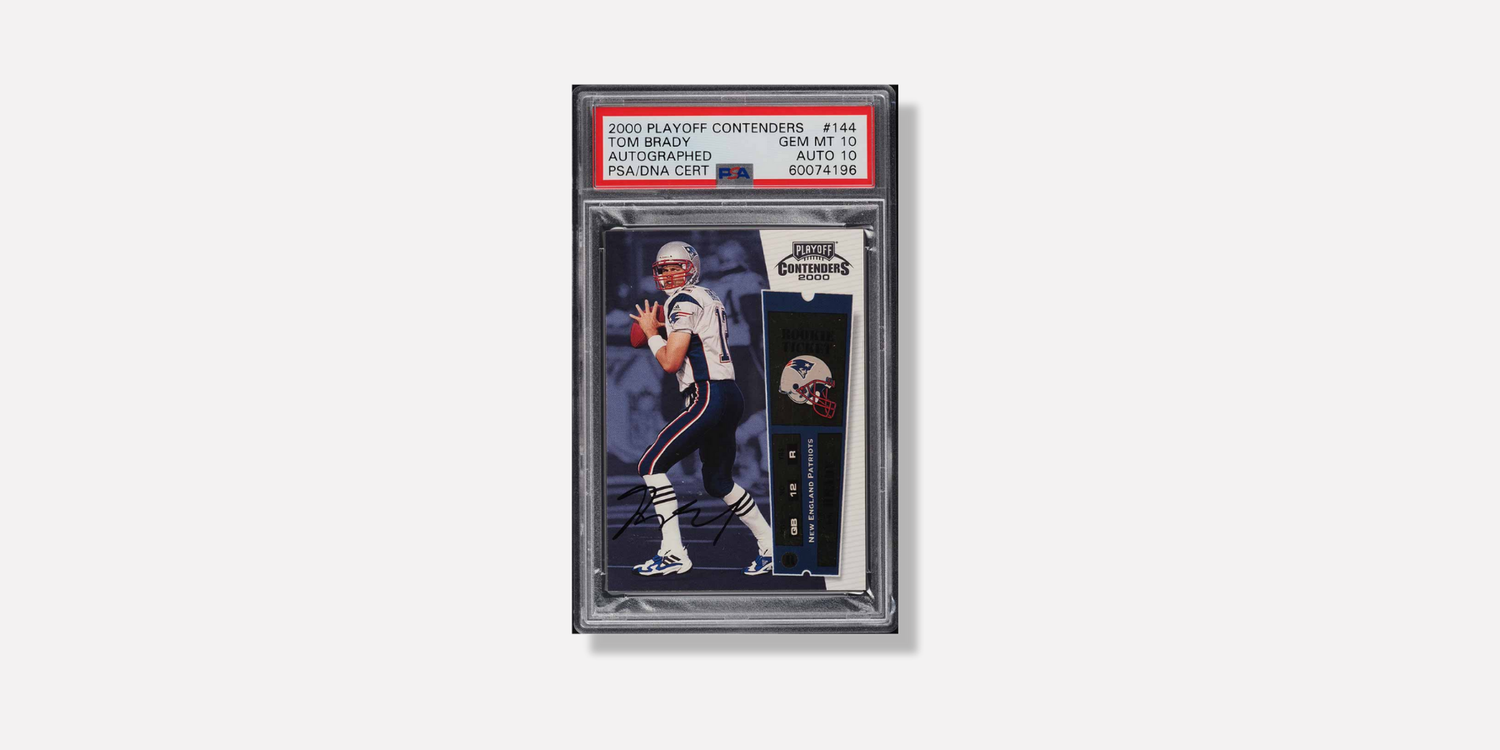
That kind of legacy inevitably creates a focal point in the card market. In modern football cards, that focal point is the 2000 Playoff Contenders Tom Brady ROOKIE RC PSA/DNA 10 AUTO #144 PSA 10 GEM MINT. Issued before the rings, records, and global recognition, it captures Brady at the exact moment before history caught up. Scarce by nature and notoriously difficult to preserve in elite condition, the card reflects the same traits that would later define his career: durability, consistency, and staying power.
As Brady’s résumé grew season after season, the hobby did what it always does with true icons—it identified one definitive rookie. This card became that benchmark, standing apart not just from other Brady cards, but from nearly every modern football card ever produced. In this guide, we’ll break down why it sits alone at the top, how Brady’s career translated into record-setting prices, and how collectors approach owning and displaying a grail of this caliber.

What You’ll Learn in This Guide
- Why Tom Brady’s career is considered the gold standard in NFL history
- What makes the 2000 Playoff Contenders #144 his definitive rookie card
- How scarcity, timing, and condition drive the card’s value
- The highest public sale prices and what they reveal about demand
- How serious collectors approach owning, displaying, and protecting a grail-level card
Tom Brady’s GOAT Journey—and Why It Made This Rookie Card Legendary
Before the Rings — The Unlikely Beginning

Long before championships became routine, Tom Brady’s path was anything but guaranteed. A multi-sport standout at Junípero Serra High School in San Mateo, California in the mid-1990s, Brady drew real interest from Major League Baseball teams while also starring on the football field. Ultimately, he chose football and enrolled at Michigan in 1995, where the road to relevance was anything but smooth. Playing time came sporadically early on, and even as a senior in 1999, Brady was locked in a highly publicized competition for snaps rather than being crowned the unquestioned starter.
That lack of spotlight carried into the 2000 NFL Draft, where Brady was selected 199th overall—a number that has since become legend. For collectors, this overlooked status matters. With minimal hype entering the league, Brady had fewer media obligations, fewer promotional appearances, and far fewer autograph commitments than top draft picks. The result was a naturally limited rookie autograph supply—scarcity created not by design, but by circumstance.

From Afterthought to Dynasty

Brady’s opportunity arrived in New England in 2001, and he didn’t waste it. Thrust into the starting role early that season, he led the Patriots to a Super Bowl victory just months later, winning Super Bowl XXXVI in February 2002. That first title validated a new quarterback archetype—poise over pedigree, execution over flash—and it marked the beginning of one of the most dominant runs in NFL history.
Between 2001 and 2018, Brady guided the Patriots to nine Super Bowl appearances, winning six championships during that span. As the titles accumulated, the hobby took notice. Championships create icons, and icons inevitably lead collectors to one defining rookie card that best represents the story.
Greatness Across Eras
True legends prove it more than once. In 2020, at an age when most quarterbacks were long retired, Brady changed teams and joined the Tampa Bay Buccaneers. One season later, he won Super Bowl LV, becoming the first quarterback to win Super Bowls with two different franchises. That second act wasn’t a footnote—it expanded his legacy beyond a single system, coach, or era and confirmed that his success translated anywhere.
The Numbers That Cemented Immortality

Longevity turned dominance into permanence. Over a career spanning 23 seasons (2000–2022), Brady retired as the NFL’s all-time leader in passing yards, passing touchdowns, and playoff wins. He appeared in 10 Super Bowls, won 7, and recorded more postseason victories than any quarterback in league history. Sustained relevance into his mid-40s reframed expectations for the position entirely.
For the card market, that kind of durability matters. It reinforces confidence that the rookie card tied to this career isn’t simply historically important—it’s culturally permanent, anchored to a résumé that may never be matched.
Tom Brady Rookie Card Value — Why #144 Sits Alone at the Top
Not all rookie cards are created equal, and even fewer become true market benchmarks. What separates this rookie card from the rest of the modern football landscape is how clearly its value drivers align—and how consistently the market has recognized them over time.
First is scarcity. Brady entered the NFL in 2000 with almost no fanfare, and that matters. Late-round draft picks didn’t receive heavy promotional pushes, extensive autograph schedules, or oversized rookie checklists. As a result, authentic on-card rookie autographs from his first year are genuinely limited, not artificially constrained. When supply starts low and demand grows exponentially, value follows.
Second is timing. This card captures Brady before the dynasty, before the records, and before hindsight rewrote his draft position into mythology. Collectors place an enormous premium on cards that exist before greatness is obvious, and this rookie sits at that exact moment. It’s not celebrating success—it’s documenting potential, which later turned into the most decorated quarterback career in NFL history.
Third is condition sensitivity. The Playoff Contenders design is notoriously unforgiving. Edge chipping, surface issues, and foil wear are common, making high-grade examples extremely difficult to find. That difficulty is a major reason elite copies command such strong premiums. When collectors talk about this card’s value, they’re not just paying for Brady—they’re paying for survival.
Finally, there’s consensus. Over time, the hobby naturally narrows its focus to one defining rookie for generational players. In Brady’s case, that process is already complete. Auction results, institutional buying, and private sales all point to the same conclusion: this is the reference card. When collectors ask what a Tom Brady rookie card is worth, this is the one the market looks to first.
Taken together—limited supply, perfect timing, extreme condition challenges, and universal recognition—it becomes clear why #144 doesn’t just lead the Brady market. It defines it. Up next, we’ll look at the hard evidence behind that status: the most expensive public sales of this rookie card and what those prices reveal about long-term demand.

Top 10 Most Expensive Sales of the #144 Rookie Auto

At the highest level of the hobby, opinions matter less than results. Public sales data offers the clearest lens into how the market values a true grail, and in this case, the signal is unusually strong. Over a concentrated two-year period, this rookie card produced ten separate seven-figure public sales, spanning multiple grades and independent auction platforms—including Fanatics Collect, Goldin Auctions, and Heritage Auctions.
What makes this data especially compelling isn’t just the headline numbers—it’s the consistency. Prices cluster tightly despite differences in grade, venue, and timing, suggesting a mature market with broad agreement on value. Rather than reacting to short-term hype or isolated results, buyers across different platforms are arriving at similar conclusions independently. That level of convergence is rare and typically reserved for assets with established historical importance and limited supply.
Below are the 10 highest recorded public sales, sorted from highest to lowest price.
|
Sale Year |
Price (USD) |
Grade |
Sale Location |
|
2021 |
$2,880,000 |
PSA 10 |
Fanatics Collect |
|
2022 |
$2,400,000 |
BGS 9 |
Fanatics Collect |
|
2022 |
$2,040,000 |
BGS 8.5 |
Fanatics Collect |
|
2021 |
$1,680,000 |
BGS 8.5 |
Goldin Auctions |
|
2021 |
$1,590,000 |
BGS 8.5 |
Fanatics Collect |
|
2021 |
$1,590,000 |
BGS 8.5 |
Heritage Auctions |
|
2021 |
$1,500,000 |
BGS 8.5 |
Goldin Auctions |
|
2022 |
$1,470,000 |
BGS 8.5 |
Fanatics Collect |
|
2022 |
$1,440,000 |
BGS 8.5 |
Fanatics Collect |
|
2022 |
$1,410,000 |
BGS 8 |
Goldin Auctions |
What These Prices Tell Collectors
This sales data shows a rare level of market agreement. Between 2021 and 2022, ten public transactions landed between $1.41 million and $2.88 million, creating a tight seven-figure range across multiple grades and auction houses. That kind of clustering signals a mature market, not speculative spikes.
The $2.88M PSA 10 sets a clear ceiling, but the real takeaway is what happens below it. BGS 9 and BGS 8.5 examples repeatedly clearing $1.5–$2.0M confirm that demand centers on owning the card itself, not chasing incremental grade jumps. Once condition reaches a high threshold, historical importance outweighs technical perfection.
Just as important, the floor holds. Even the lowest sale—a BGS 8 at $1.41M—remains firmly in seven figures, suggesting strong downside support driven by scarcity and legacy. Consistent results across multiple auction platforms reinforce this as a consensus asset, not a moment-in-time outlier.

Buying the Card Today — What Serious Collectors Look For
At this level of the hobby, buying the card is about precision, not urgency. Elite examples tend to surface through established venues like Fanatics Collect, Goldin Auctions, and Heritage Auctions, where provenance and grading confidence are clear.
Grade matters, but context matters more. Recent sales show that once condition reaches a high threshold, eye appeal and autograph quality often outweigh small numerical differences. Collectors focus on how a copy compares to recent comps, not just the label on the slab.
Patience is part of the process. This rookie card trades infrequently but predictably, rewarding buyers who wait for the right example at a defensible number. At this tier, the smartest move is often knowing when not to buy.
Displaying and Protecting a Card of This Caliber
If you own a card like this, hiding it away never feels right. Grail cards are meant to be seen—displayed the way artwork is displayed. Clean, intentional, and permanent.
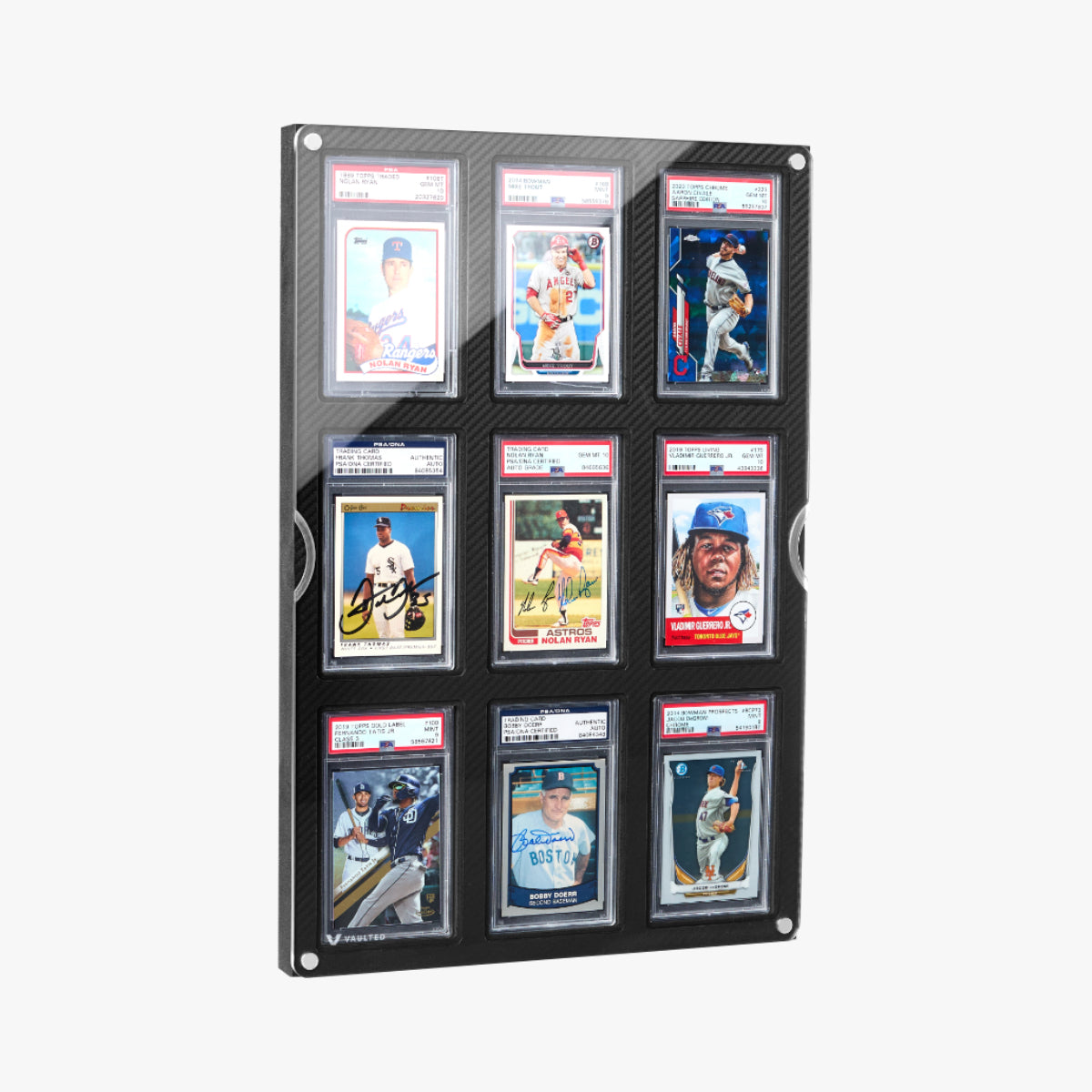
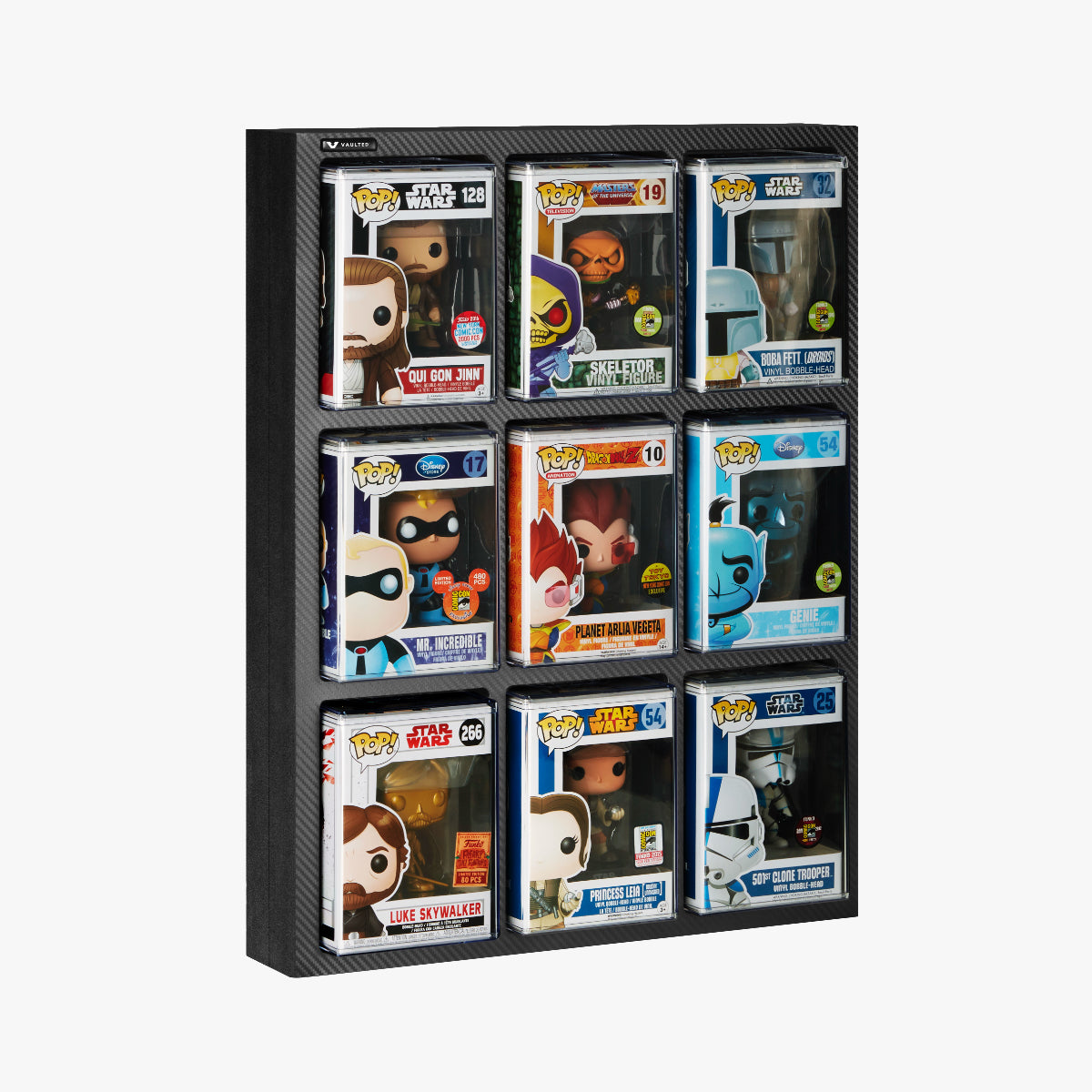
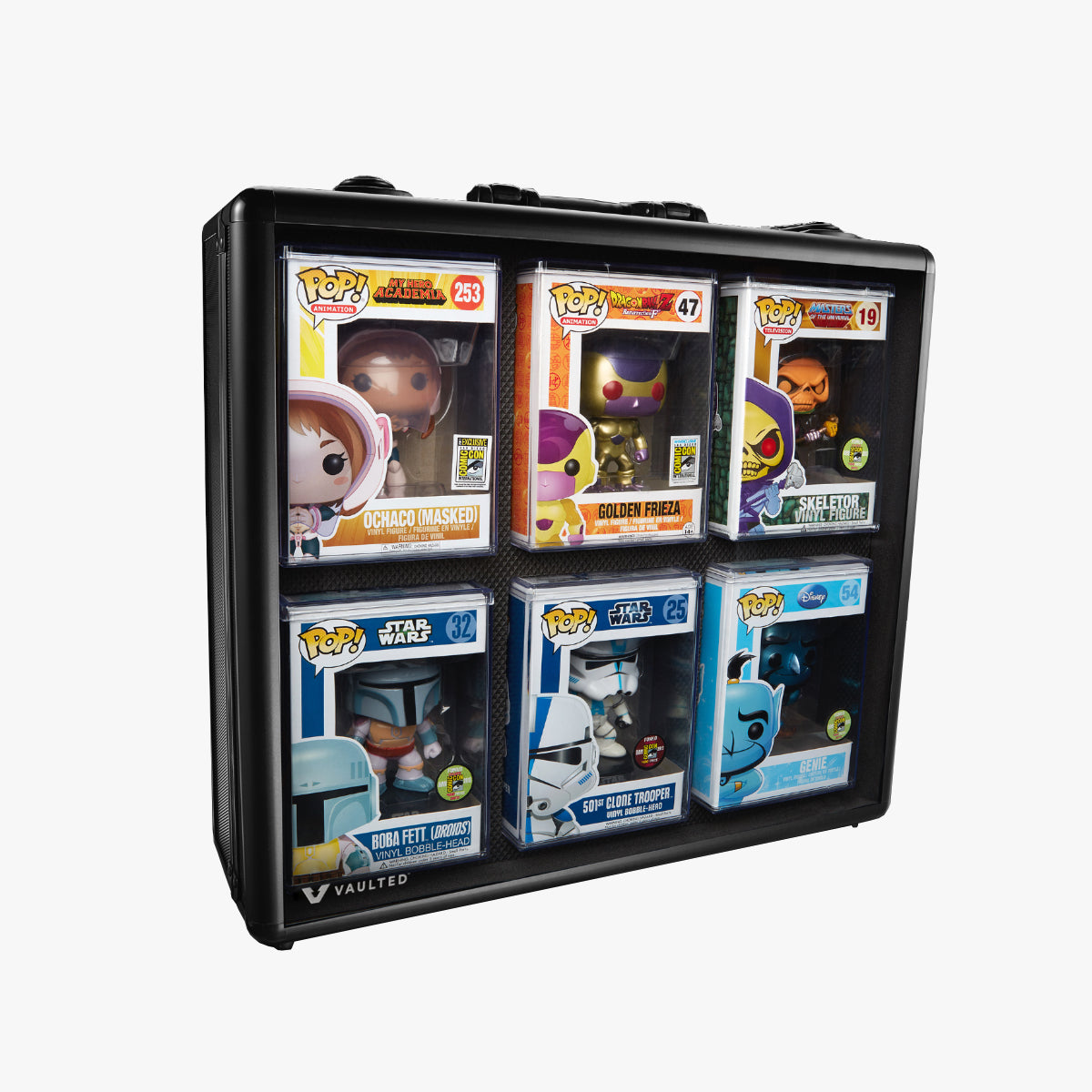
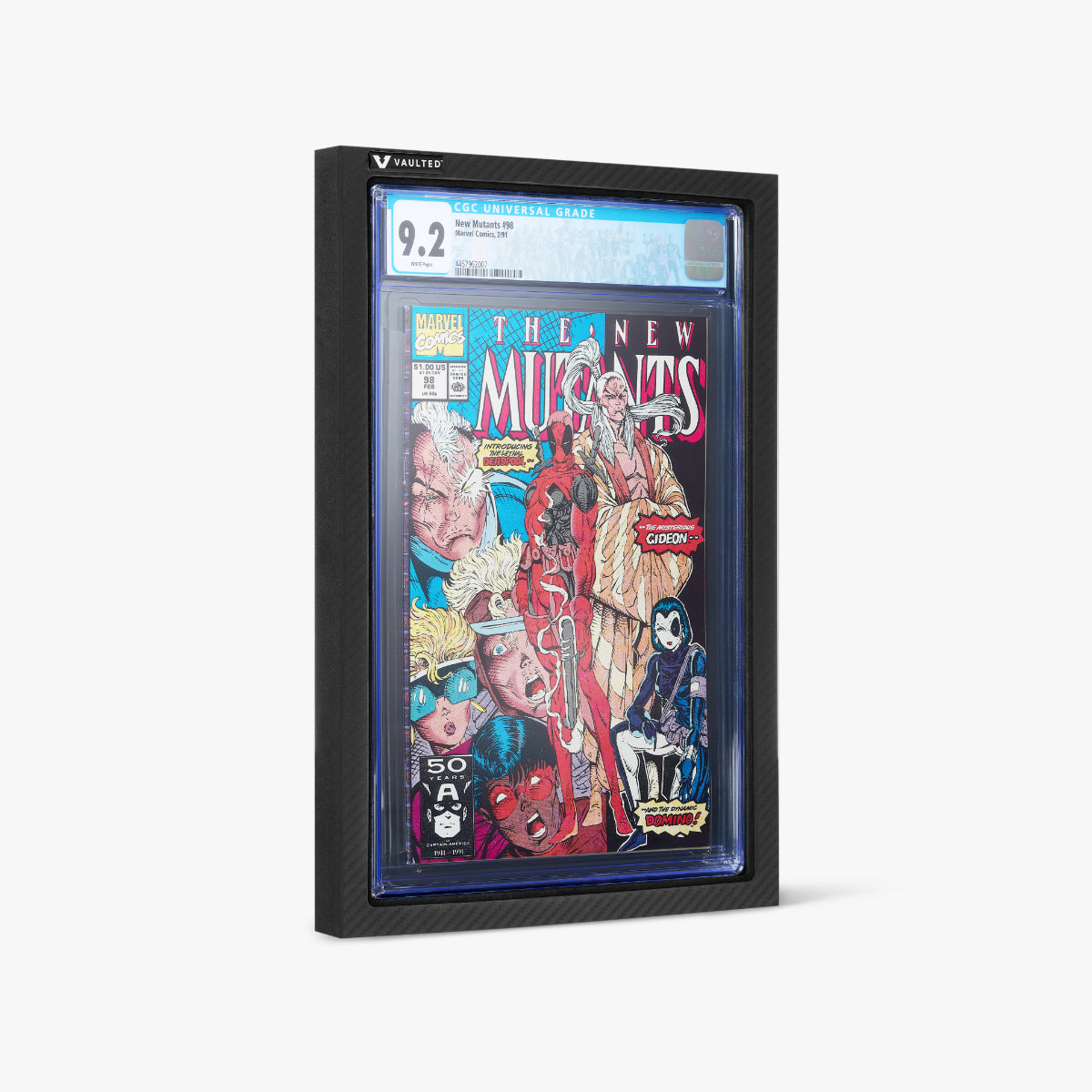
That’s where the Card Display for BGS by Vaulted fits naturally. Designed for wall mounting with a museum-style look, it installs easily with no complicated hardware and no bulky mounts. The friction-fit foam holds a BGS slab securely in place, while the carbon fiber finish gives the display a professional, modern feel that doesn’t distract from the card itself.
For collectors, it’s the obvious choice when protection and presentation matter equally. The card stays secure, upright, and on display—exactly where a piece of NFL history like this belongs.
Up next, we’ll wrap up with a quick FAQ covering the most common questions collectors ask about Tom Brady and his iconic rookie card.
FAQ
What is the most valuable Tom Brady rookie card?
The most valuable Tom Brady rookie card is the 2000 Playoff Contenders Tom Brady ROOKIE RC PSA/DNA 10 AUTO #144 PSA 10 GEM MINT. Public sales have reached nearly $3 million, making it the clear benchmark not only for Brady cards, but for modern football cards as a whole. Its value comes from true scarcity, extreme condition sensitivity, and direct association with the greatest quarterback career in NFL history.
How much is a Tom Brady rookie card worth?
That depends heavily on which rookie card and what condition. Common Brady rookies can sell for a few hundred dollars, while premium, authenticated rookie autographs climb into six figures. At the very top of the market, elite examples of the #144 Rookie Ticket Auto consistently trade in the seven-figure range, with strong demand even below perfect grades.
What is the best Tom Brady card to invest in?
For collectors focused on long-term significance rather than short-term trends, the consensus answer is his Playoff Contenders Rookie Ticket Auto #144. It’s widely viewed as Brady’s definitive rookie card—the one institutions, high-end collectors, and major auction houses use as the reference point for his entire market. While no card is risk-free, this rookie combines scarcity, legacy, and historical importance in a way few modern cards ever have.