

Charizard Pokémon Card Explained: History, Rarity, Power & Value
The Charizard Pokémon card doesn’t need an introduction in collector circles. Since its release in the Base Set in 1999, it has been the card everything else gets compared to. Whether someone pulled it from a pack as a kid or started chasing it seriously years later, Charizard has always sat at the top of the hobby’s hierarchy.
The original charizard card was one of the first holographic cards most players ever saw, and it immediately felt different. Dark artwork, aggressive pose, heavy holo bleed on early printings — it stood out then, and it still does now. As the hobby matured and grading became standard, collectors realized just how few early copies survived in clean condition. That realization is what separated a common childhood memory from a true blue-chip collectible.
When people talk about a charizard card today, they’re usually talking about editions, not just the Pokémon. The charizard first edition, shadowless variants, and later premium releases all tell different parts of the same story. Population reports, auction records, and long-term price behavior have turned Charizard into a case study for how scarcity and condition really work in Pokémon collecting.
This article breaks that story down properly. We’ll cover where Charizard came from, why early versions like the 1st edition charizard matter so much, how gameplay identity influenced demand, and why Charizard continues to dominate discussions around charizard pokemon card value and the most expensive charizard card. No hype, no shortcuts — just the information collectors actually care about.

What Makes the Charizard Pokémon Card So Legendary?
The Charizard Pokémon card became legendary because it arrived at the exact moment the Pokémon Trading Card Game took hold in the United States. Released in the Base Set in 1999, it helped define what a chase card looked like before the concept was even formalized. The pokemon charizard card wasn’t elevated later by marketing or rarity engineering — it set the standard from day one.
Presentation played a major role. The holographic charizard stood apart from the rest of the set, particularly on early Base Set printings known for darker tones and noticeable holo bleed. Even among other holographics, Charizard felt more aggressive and more powerful, which mattered in an era when most collectors were discovering the game visually, not statistically.
Condition scarcity is where legend turned into long-term value. Early Charizard cards were notoriously difficult to keep clean, with centering issues, edge wear, and surface flaws common straight out of packs. Once grading became standard, it was clear how few high-grade copies existed. This is why the gap between a raw copy and a psa 10 first edition charizard remains one of the largest in the hobby.
Charizard’s position has never reset. Every major shift in Pokémon collecting — grading adoption, auction visibility, record-setting sales — has reinforced its status. When collectors evaluate charizard pokemon card value, research the most expensive charizard card, or compare editions across eras, Charizard remains the reference point.

The Origin Story of Charizard
The importance of the charizard pokemon card starts with Charizard’s role in the Pokémon universe itself. Long before grading reports, population data, or auction records existed, Charizard was already positioned as something harder to reach and more powerful than most Pokémon players encountered early on. That foundation explains why the charizard pokemon card carried so much weight from the moment it entered the trading card game.
Charizard was never introduced as a casual or disposable character. Its in-game difficulty, visual design, and late-stage evolution all contributed to how players perceived it, and that perception transferred directly to the pokemon charizard card when it debuted.
From Charmander to Charizard: Evolution Explained

Charizard sits at the end of one of the original starter evolution lines: Charmander, Charmeleon, and finally Charizard. Choosing Charmander in the original games meant committing to a more difficult early experience in exchange for a powerful final evolution. That tradeoff shaped how players viewed Charizard long before the charizard pokemon card existed.
By the time Charizard appeared, it represented progression, effort, and payoff. This perception carried cleanly into the trading card game. The charizard pokemon card wasn’t just another Fire-type Pokémon; it was the visual and symbolic reward for sticking with a tougher path. That context matters, because early Pokémon cards were understood emotionally before they were evaluated technically.
Charizard’s First Appearance in Pokémon History
Charizard first appeared in the original Pokémon Red and Blue games released in Japan in 1996 and later in the United States in 1998. Its trading card debut followed shortly after with the Base Set release in 1999, marking one of the earliest appearances of a fully evolved starter Pokémon as a holographic rare.
The original charizard card was part of that first US Base Set print run, making it one of the earliest high-impact holographics available to players and collectors. At the time, distribution was wide and preservation was not a priority. Cards were played heavily, traded frequently, and rarely sleeved. That environment is a major reason early copies of the charizard pokemon card — especially the charizard first edition — are so scarce in high condition today.
This combination of early game prominence and immediate trading card visibility created a perfect overlap. The charizard pokemon card wasn’t introduced slowly or rediscovered years later. It entered the hobby at full force, during Pokémon’s peak growth, and was used exactly as a trading card was meant to be used at the time. That reality set the stage for everything that followed.
The Most Expensive Charizard Pokémon Cards Ever Sold
When collectors talk about the most expensive charizard card, they are almost always referring to early Base Set Charizard releases in elite condition. While many charizard cards hold value, only a handful sit at the very top of the market, led by the original 1st edition charizard.
These sales matter because they establish real benchmarks. They show how scarcity, condition, and documented history combine to define long-term charizard pokemon card value.
1st Edition Base Set Charizard (Shadowless)

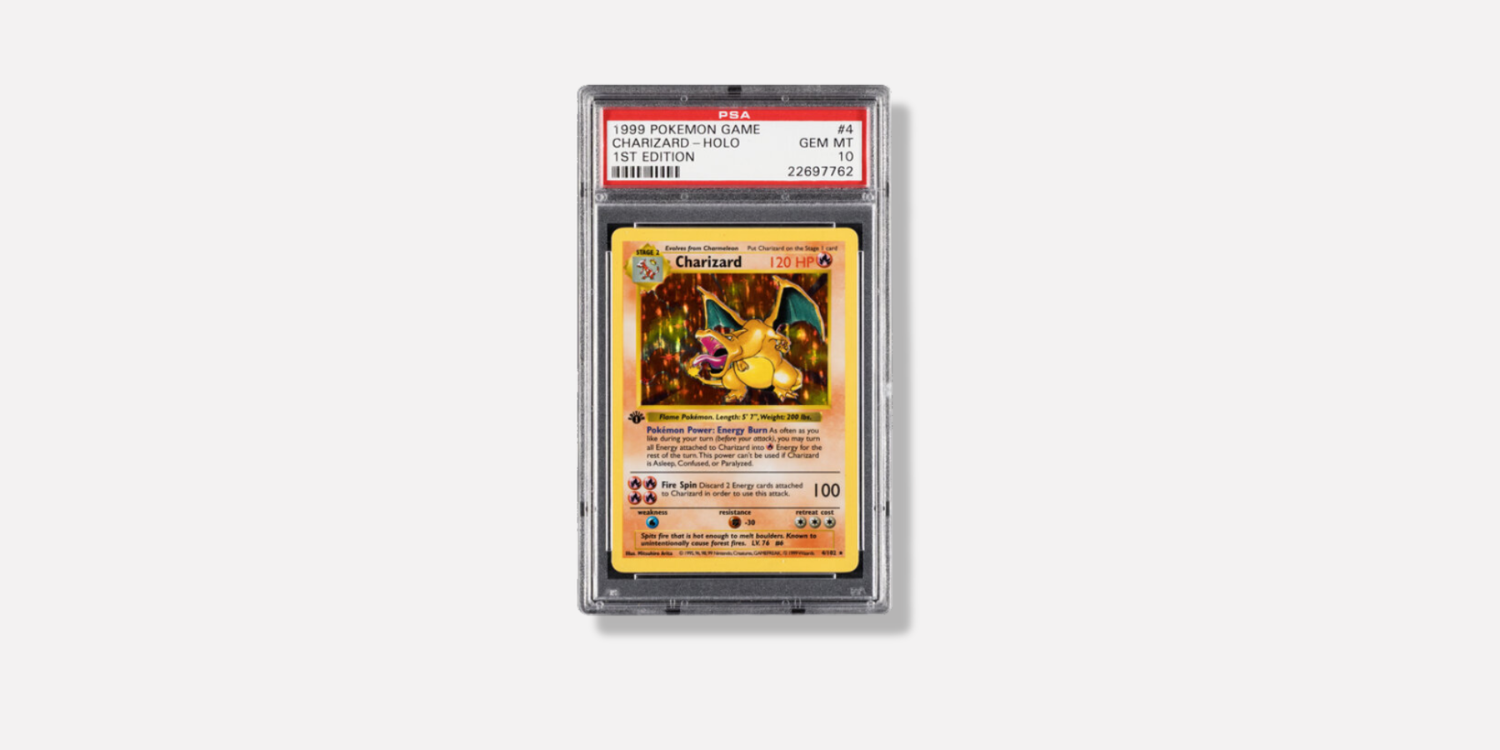
The first edition charizard from the 1999 Base Set remains the most important Charizard card ever printed. Identified by the “Edition 1” stamp and shadowless frame, it represents the earliest US distribution of the original charizard card.
In December 2025, a PSA 10 first edition charizard sold for $550,000 USD at Heritage Auctions, setting a new public auction record. The sale confirmed what collectors had already understood for years: the psa 10 charizard 1st edition exists in numbers far smaller than demand suggests. Out of nearly 5,000 graded copies, only around 120 have reached Gem Mint condition.
Earlier sales reinforced this trajectory. In October 2020, another PSA 10 example sold for $220,574 USD, marking the moment Charizard firmly entered the top tier of modern collectibles.
Other High-Value Charizard Cards
Beyond Base Set, several rare charizard card releases have achieved significant prices. Japanese Trophy Charizard cards, distributed exclusively at early competitive events, are among the rarest Charizard issues ever produced and are typically sold through platforms such as Goldin and Fanatics Collect.
The Shining Charizard from Neo Destiny remains another key card for advanced collectors, particularly in high grade, where surface sensitivity limits supply. Modern premium releases, including gold variants often referred to as a golden charzard, also command attention, though their value relies more on controlled scarcity than early-era usage.
Why These Sales Matter
These sales define the top end of the Pokémon market. When collectors evaluate pokemon cards charizard, compare editions, or research long-term trends, these figures provide the reference points.

Charizard Card Variants Every Collector Should Know
Not all charizard cards are equal. Small differences in early production created clear tiers that still define value today. Knowing these variants is essential when evaluating pokemon cards charizard listings or comparing all charizard cards across eras.
Base Set Variants

The Base Set charazard card exists in three English versions.
The charizard first edition is the earliest US release, identified by the “Edition 1” stamp and shadowless border. These cards anchor the high end of the market, including the record-setting psa 10 charizard 1st edition.
Shadowless Charizard cards came next. They lack the edition stamp but share the same frame style. Scarcer than later prints, they remain highly desirable among vintage collectors.
Unlimited Base Set Charizard cards include the drop shadow and are the most common version. While still collectible, they sit well below first edition and shadowless cards in value.

English vs Japanese Charizard Cards
Japanese Charizard cards were printed earlier and with tighter quality control, often resulting in better centering. Despite this, English early releases carry stronger demand in the US market and consistently lead pricing discussions around charizard pokemon card value.
Modern Charizard Cards
Modern pokemon charizard card releases include V, VMAX, EX, GX, and gold variants often referred to as a golden charizard. These rely on controlled scarcity and high-grade preservation, making them fundamentally different from vintage cards.
When collectors refer to a rare charizard card, they are usually talking about early Base Set or limited-distribution releases — not modern reprints.
Charizard’s position is not based on hype cycles alone. It is built on early release timing, heavy historical use, and limited preservation — a combination that remains difficult to replicate.
Charizard’s Powers in the Pokémon Trading Card Game
The legacy of the charizard pokemon card isn’t built on artwork and rarity alone. From the beginning, Charizard was positioned as a high-impact card within the Pokémon Trading Card Game, and that gameplay identity played a major role in how the card was perceived by early players and collectors.
Early Charizard Gameplay Identity
The original charizard pokemon card from the Base Set featured high damage output paired with meaningful drawbacks. Attacks like Fire Spin required large energy commitments and forced energy discards, making Charizard powerful but risky. This risk-reward design reinforced the idea that Charizard was not an easy card to use, but a rewarding one when played correctly.
For many players, pulling the charizard pokemon card meant more than owning a rare card — it meant having access to one of the strongest offensive options in early gameplay. That perception carried into how the card was traded, valued, and protected, even before collectors fully understood long-term rarity.
Competitive Impact and Perception
In competitive play, the charizard pokemon card was never dominant in the same way as later optimized decks, but its presence mattered. It shaped how players thought about energy acceleration, deck construction, and late-game power. More importantly, it reinforced Charizard’s identity as a high-ceiling Pokémon, both in battle and in collecting.
This gameplay reputation added another layer to the card’s appeal. Charizard wasn’t just visually impressive or hard to pull — it felt powerful in use. That feeling matters when evaluating why the charizard pokemon card retained relevance long after many early cards faded into obscurity.
Long-Term Effect on Collectibility
The combination of strong artwork, early scarcity, and gameplay identity helped anchor Charizard at the top of the hobby. Even today, when collectors evaluate charizard pokemon card value, gameplay legacy remains part of the broader narrative. It explains why Charizard endured as a symbol of power rather than just a nostalgic image.

Fun Facts Only Real Charizard Collectors Know
-
The original charizard pokemon card is a Fire/Flying type, not a Dragon, despite Charizard’s appearance. Dragon typing was introduced later, making early Charizard cards a frequent point of discussion among collectors.
-
Early Base Set charizard pokemon card copies show noticeable print variation, including centering differences, darker color tones, and inconsistent holographic patterns. These factors contribute to why two cards with the same grade can present very differently.
-
The charizard pokemon card is one of the most submitted Pokémon cards to PSA, yet early versions remain among the hardest to achieve Gem Mint grades on due to surface sensitivity and edge wear.
-
Minor factory inconsistencies have led collectors to scrutinize listings closely, especially when unusual descriptions or spelling variations appear in marketplaces. Experienced buyers know these require careful inspection rather than assumption.
-
Few Pokémon cards have achieved the same level of mainstream recognition. The charizard pokemon card is often used as shorthand for high-end Pokémon collecting, even outside dedicated hobby spaces.

FAQS
| Card Type | Typical Value Range (USD) |
|---|---|
| Modern Charizard (ungraded) | $10–$200 |
| Charizard ex | $20–$2,000+ (graded top) |
| Vintage Shadowless Charizard | $3,000–$50,000+ |
| First Edition Charizard PSA 9 | ~$80,000–$200,000+ |
| First Edition Charizard PSA 10 | ~$200,000–$550,000+ |
How much is a Charizard ex worth?
For high-demand Charizard ex cards (e.g., Charizard ex from Pokémon TCG: EX FireRed & LeafGreen or similar sets):
-
Mid-grade (ungraded/played): Typically ranges from $20–$100 USD, depending on condition and seller.
-
Near-mint / excellent condition: Often around $100–$300 USD.
-
Graded (PSA 9 – Mint): Commonly in the $300–$800 USD range, depending on edition.
-
PSA 10 – Gem Mint: Can reach $800–$2,000+ USD for the most popular versions
Note: The value varies a lot by set, edition, and supply — but Charizard ex cards are generally collectible and can command high prices when graded at top condition.
How much is a Charizard worth?
“Charizard” without additional qualifiers covers a wide range of cards. Here’s a rough breakdown based on typical market behavior:
-
Modern Charizard cards (ungraded): Most newer Charizard cards sell for $10–$200 USD.
-
Older non-Base Set Charizard cards (Neo, EX era): Depending on set and condition, these often sell for $50–$1,000 USD.
-
Graded mid-tier Charizard cards (PSA 8–9): Can sell from $200–$1,500 USD depending on print and edition.
This category includes many Charizard cards, so prices are broad. The value depends on edition, rarity, condition, and demand.
How much is a First Edition Charizard worth?
When people ask “how much is a first edition Charizard worth,” they are typically referring to the 1st Edition Base Set Charizard from 1999 — the most iconic Charizard card in the hobby.
Approximate values (as of the latest documented sales):
-
Ungraded (played/poor condition): Often $3,000–$15,000+ USD, depending on condition.
-
High-grade raw (near-mint): Commonly $15,000–$80,000+ USD.
-
PSA 9 – Mint: Typically $80,000–$200,000+ USD, depending on current market conditions.
-
PSA 10 – Gem Mint: Can range from $200,000 USD to record-setting levels. A PSA 10 first edition Charizard has sold for $550,000 USD, which currently stands as one of the highest publicly documented sales for any Pokémon card.
These values reflect auction results, grading population scarcity, and consistent collector demand.
How much is a Charizard card worth?
This is very broad because there are dozens of Charizard cards from multiple sets. Here’s a simplified guide:
-
Modern Charizard cards: $10–$200+ USD (ungraded), rising with condition and rarity.
-
Older non-Base Set issuances: $50–$1,000+ USD, depending on edition and condition.
-
Vintage Charizard (Base Set):
-
Unlimited and shadowless: Thousands of USD, rising with condition.
-
First Edition (Base Set): Tens of thousands to hundreds of thousands of USD in high grade.
In short, a charizard card can be worth:
-
$10 (common modern print)
-
$100–$1,000 (mid-tier vintage/non-Base Set)
-
$2,000–$550,000+ (top-tier vintage first edition in high grade)