

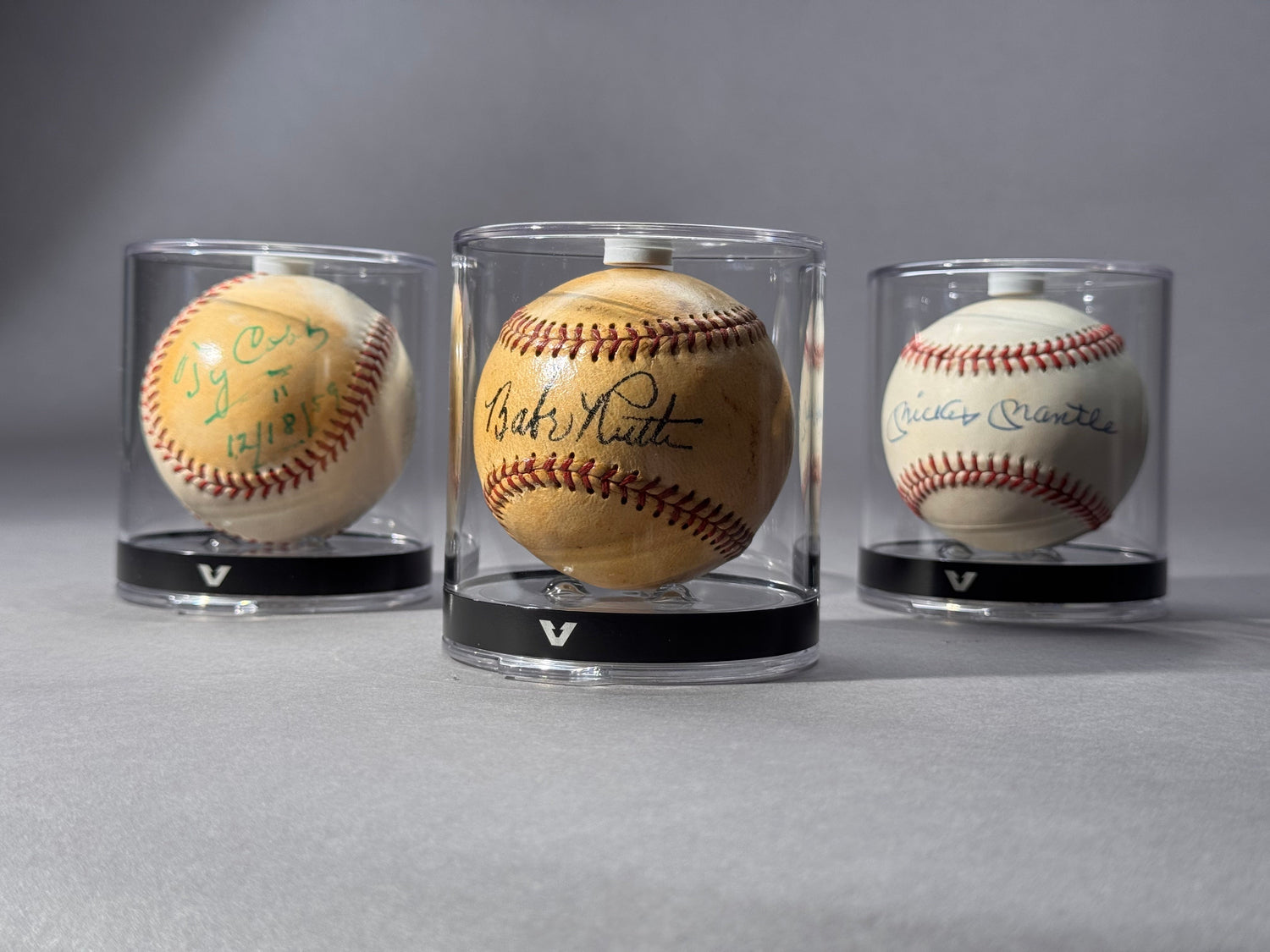
Babe Ruth Autographed Baseball: Value, Authentication & Where to Buy One
There are collectibles, and then there is a Babe Ruth autographed baseball. No other object in American sports memorabilia carries the same weight: literally a piece of cowhide that Ruth's own hand once touched, bearing the signature of a man who redefined what it meant to be an athlete. Whether you're a seasoned collector pricing your next acquisition or a first-time buyer wondering if a signed Babe Ruth baseball is worth the investment, this guide covers everything: history, value, authentication, where to find one, and, crucially, how to keep it in perfect condition once it's yours.
Why a Babe Ruth Signed Baseball Is the Holy Grail of Sports Memorabilia
The Legend Behind the Signature: Who Was Babe Ruth?

George Herman Ruth Jr. was born on February 6, 1895, in Baltimore, Maryland. By the time he retired in 1935, he had rewritten virtually every offensive record in the sport. His 714 career home runs stood as the all-time record for nearly four decades. His single-season mark of 60 home runs in 1927 lasted 34 years. He carried a lifetime batting average of .342 and holds the all-time MLB record for career slugging percentage at .690 and career OPS at 1.164, numbers that still hold up against modern analytics more than 75 years after his death.
Fun fact: Ruth wasn't just a slugger. Before the Yankees turned him into baseball's greatest hitter, he was a dominant left-handed pitcher for the Boston Red Sox, finishing his pitching career with a 94–46 record and a 2.28 ERA. In the 1916 and 1917 World Series, he threw 29.2 consecutive scoreless innings, a record that stood for 43 years.
Known by nicknames that still echo in American culture, "The Bambino," "The Sultan of Swat," "The Colossus of Clout," Ruth was more than an athlete. He was the first true American sports celebrity, a cultural force who shaped professional baseball into a national obsession. As his former teammate Joe Dugan once said: "To understand him, you had to understand this: He wasn't human."
How Many Babe Ruth Signed Baseballs Are There?
This is one of the most searched questions in the hobby, and the answer is nuanced. Ruth was famously generous with his autograph: prior to his arrival in the major leagues, signing autographs was not commonplace, but Ruth went out of his way to be accessible to fans of all ages. He signed at games, at spring training, at charity events, at restaurants, even in hospital beds.
That said, signed Babe Ruth baseballs from his actual playing career (1914–1935) are extremely rare. The majority of authenticated examples were signed after his retirement. A Florida man once recalled that Ruth repeatedly signed baseballs for him at spring training sessions during the 1920s and 1930s, and he regrettably sold them all to feed his family during the Depression. Those balls are gone, scattered into history.
There is no official count of surviving authenticated examples, but PSA, the leading authentication service, has graded thousands of Ruth signatures across all mediums. Single-signed baseballs specifically from his playing years are among the rarest forms of Babe Ruth memorabilia in existence.
Collector insight: A small but important caveat: not every "Babe Ruth" signature on a baseball was actually signed by Ruth himself. As part of a 1937 Sinclair Oil promotion, a secretary signed "Sincerely Babe Ruth" on baseballs sent to contest winners. In the 1920s, a clubhouse attendant occasionally signed items on his behalf. This is exactly why professional authentication is non-negotiable.
Why Collectors Consider It the Most Iconic Baseball Autograph of All Time
Of the top ten highest-selling pieces of sports memorabilia ever, four belong to Babe Ruth. No other athlete comes close. His babe ruth autograph isn't simply a signature, it is a direct, tactile connection to the man who built modern baseball. Every time a Ruth-signed baseball changes hands at auction, it sets or approaches a record. The demand has never softened, and with each passing decade, fewer examples enter the market.
How Much Is a Babe Ruth Autographed Baseball Worth?
Understanding babe ruth autographed baseball value requires understanding that there is no single price, the market is a spectrum, and where a given ball lands on that spectrum depends on a constellation of factors.
Price Ranges by Condition and Era
To answer the most common question collectors ask, how much is an autographed Babe Ruth baseball worth? Here is a practical breakdown by condition and period:
|
Era / Context |
Approximate Range |
|
1910s–1920s (playing career, well-preserved) |
$100,000–$400,000+ |
|
1930s (late career, strong signature) |
$50,000–$150,000 |
|
1940s–1948 (post-retirement) |
$20,000–$80,000 |
|
PSA/JSA-authenticated, grade 7–8 |
$30,000–$137,000 |
|
PSA 9–10 (near mint to gem mint) |
$150,000–$400,000+ |
|
Personalized inscriptions |
Typically 20–40% lower than non-personalized |
A babe ruth autographed ball from the 1940s and a playing-era example from the 1920s are entirely different propositions, separated by rarity, condition probability, and collector demand. So how much is a babe ruth autographed baseball worth in practical terms? For most authenticated examples reaching the open market today, expect to see prices ranging from the low $20,000s for a later-life signature in average condition, to well over $100,000 for a pristine, playing-era ball with clean provenance.
Record-Breaking Auction Sales
The auction record for a single-signature Babe Ruth baseball (without an inscription) was set at Heritage Auctions in 2012, when a PSA/DNA Mint+ 9.5 example sold for $388,375. That ball remains a benchmark.

But some of the most compelling sales involve the stories behind the balls:
-
The "Last Baseball He Ever Signed" ($183,500, Grey Flannel Auctions): Ruth was battling cancer in the summer of 1948. After a doctor's appointment, he stopped at a restaurant, where a waiter asked him to sign a baseball for his daughter's birthday. Ruth initially refused, then returned from his car, signed it "To Loraine," and went back to Memorial Hospital. He passed away the following evening on August 16, 1948. PSA graded the autograph a perfect Mint 10.
-
The Johnny Sylvester Ball ($250,641, Grey Flannel Auctions, 2014): In 1926, Ruth signed a baseball for an ailing 11-year-old boy with the message: "I'll knock a homer for Wednesday's game." He proceeded to hit three home runs in Game 4 of the 1926 World Series. The boy's condition reportedly improved dramatically. That ball sold for over a quarter of a million dollars, not just for the signature, but for the story.
-
The 1939 Hall of Fame Induction Ball ($632,369, SCP Auctions, 2018): Eleven first-class Hall of Fame inductees signed a single baseball at the very first induction ceremony in Cooperstown: Ruth, Ty Cobb, Honus Wagner, Cy Young, Walter Johnson, and six others. It sold for a world record for any non-game-used signed baseball, a number that had increased more than tenfold from its 1997 Christie's price of $55,000.
-
A 2023 Lelands auction: A PSA NM-MT 8 Ruth single-signed ball from the personal collection of former Boston Braves catcher Phil Masi, signed during the late 1940s, realized $137,620.
What Factors Affect the Value of a Babe Ruth Signed Ball
When assessing babe ruth signed baseball value, professionals weigh:
Signature grade: PSA and JSA grade signatures on a 1–10 scale. A grade 8 (NM-MT) is excellent; a grade 10 (Gem Mint) is exceptional and commands a massive premium.
Sweet spot placement: A babe ruth autograph signed across the sweet spot of the ball (the widest leather panel, opposite the seams) is the most desirable presentation. PSA even notes the position on the certification label.
Ink type and preservation: Ruth typically signed in blue or black fountain pen. Bright, unfaded ink is a positive indicator; oddly vibrant ink on a supposedly 80-year-old ball is a red flag.
Ball type: An official American League or National League ball commands more than a generic baseball. Official league balls confirm a provenance connection to the game itself.
Provenance documentation: Who owned it, who witnessed the signing, and how it passed hands since. The Phil Masi ball sold for six figures in part because Masi was a known figure who personally obtained the signature at spring training.
Personalization: Counterintuitively, a "To Johnny, Best Wishes, Babe Ruth" inscription typically lowers value compared to a clean "Babe Ruth" solo signature. Collectors prefer non-personalized examples.
Babe Ruth + Lou Gehrig Dual-Signed Baseball: A Rarer Collectible

If a single signed babe ruth baseball is rare, a dual-signed ball bearing both Ruth and Lou Gehrig is in a category of its own. The two legends did not always see eye to eye: Ruth tended to dominate the spotlight in ways that overshadowed even Gehrig's staggering career. Their relationship was complex, and co-signed pieces from their overlapping Yankees years (1923–1934) are exceptionally scarce.
A Miller & Miller auction in January 2025 featured two baseballs from the late 1920s and early 1930s, including a dual-signed example authenticated by JSA, estimated at CA$15,000–$20,000. As Justin Miller noted: "It's very rare to see autographs of the two top guys on the same ball."
How to Authenticate a Babe Ruth Autographed Baseball
Authentication is not optional, it is the foundation on which any serious purchase of babe ruth memorabilia must rest. Ruth's signature is, by most accounts, the most forged autograph in sports history. His legible cursive style makes it easy to imitate, and the enormous value of authentic pieces makes it an attractive target for forgers.
The Major Authentication Services: PSA, JSA, and Beckett
PSA (Professional Sports Authenticator) is the industry gold standard. They grade both the autograph and the ball independently and assign an overall grade. Their database is publicly searchable, meaning any certified Ruth ball carries a unique certification number you can verify online. PSA also offers a specific "Autograph Facts" profile for Ruth that documents known signature variants by era.
JSA (James Spence Authentication) is PSA's main rival and highly respected. Many dealers and auction houses accept JSA-certified pieces at equivalent standing to PSA. JSA provides a Letter of Authenticity (LOA) and a sticker certification.
Beckett Authentication Services (BAS) rounds out the top three. Equally trusted by major auction houses.
Rule of thumb: Never purchase a babe ruth authentic signed baseball without a PSA or JSA certification. Period.
How to Spot a Fake Babe Ruth Signature: Red Flags
Even with authentication, an educated collector's eye is your first defense. Key red flags:
-
Ink color: Ruth signed in blue or black fountain pen. If the ink appears unusually bright or greenish on an allegedly decades-old ball, that is a significant warning sign.
-
Ball condition inconsistency: A near-mint ball with a supposedly 1930s signature invites scrutiny, as leather ages.
-
Missing letter characteristics: An authentic babe ruth signature always shows a curl on the left side of the "B" and two distinguishable, rounded segments, with the top at a slight upward angle. The baseline may droop slightly at the "t" in Ruth.
-
Quote marks around "Babe": Ruth used quotation marks around "Babe" during the 1920s and dropped this practice by the late 1920s. Finding them on a ball dated to 1935, for example, is anomalous.
-
Too clean: A baseball signed in the 1920s or 1930s that looks as though it just left a sporting goods store shelf warrants extreme caution.
Ruth's Signature Evolution: How It Changed from the 1920s to the 1940s
This is the detail that separates serious collectors from casual buyers, and it is a genuine content gap that most articles never address.
According to PSA's principal autograph authenticator Kevin Keating: "Ruth's signature evolved over the course of his lifetime. To authenticate one, you must consider many elements, including the time period Ruth signed the item."
Here is a practical guide to what to look for by decade:
1910s (Red Sox years): Ruth's early signature was less confident, more tentative. Rarely seen on baseballs from this period.
1920s (early Yankees years): The signature became bolder and more developed. Ruth notably placed quotation marks around "Babe" during this period, a distinctive quirk he eventually dropped. His Yankees-era autographs are among the most visually striking he produced.
Late 1920s–1930s: The quotation marks disappeared. The signature became consistent, confident, and highly legible, his most recognizable period. Ruth signed "Babe Ruth" on baseballs virtually without exception, always across the sweet spot.
1940s (post-retirement and illness): As Ruth battled throat cancer, his signature showed increasing shakiness and reduced pen pressure. Late-life Ruth signatures have their own character, still unmistakably his, but visibly different from his peak-Yankees examples. A PSA grade reflects this context.
Critical insight for authentication: Ruth occasionally signed his name in multiple ways: "George Herman Ruth" on contracts, "G.H. Ruth" on checks, "Babe" on casual photos for friends. But on baseballs, he almost always signed simply "Babe Ruth." A baseball signed "George Herman Ruth" should prompt immediate scrutiny.
Where to Buy a Babe Ruth Autographed Baseball
Whether you are entering the hobby or adding to a serious collection, knowing where to find a babe ruth autographed baseball for sale from a legitimate source is critical.
Major Auction Houses
The gold standard for acquiring high-value babe ruth memorabilia is a reputable auction house. These platforms require full authentication before listing and provide detailed provenance documentation:
-
Heritage Auctions (ha.com): the world's largest collectibles auction house with deep expertise in sports memorabilia. They set the 2012 record of $388,375 for a Ruth single-signed ball.
-
SCP Auctions: specialists in high-end sports memorabilia, sold the 1939 Hall of Fame ball for $632,369.
-
Lelands: top-tier auction house with rigorous authentication, realized $137,620 for a Phil Masi-provenance Ruth ball in 2023.
-
Grey Flannel Auctions: handled both the Johnny Sylvester ball and the "last baseball signed" sale.
-
Memory Lane Inc.: strong catalog for vintage autographs, regularly features PSA Gem Mint Ruth items.
What to Verify Before Buying Anywhere
Whether purchasing at auction, through a dealer, or on an online marketplace:
-
Confirm the PSA or JSA certification number independently on their official websites
-
Request full provenance documentation, chain of ownership matters
-
Ask for high-resolution photos of the sweet spot and all ball panels
-
Understand the return policy if authentication is disputed post-purchase
-
For online marketplaces, use escrow services for high-value transactions
Why Provenance Documentation Matters More Than Price
Two Ruth baseballs with identical PSA grades can carry very different values depending on their story. The Phil Masi ball sold for $137,620 in part because Masi was a known player who obtained the signature personally. The Johnny Sylvester ball sold for $250,641 because the story attached to it is documented in historical newspaper accounts. Provenance doesn't just authenticate, it humanizes the object and deepens its cultural meaning.
When you purchase from a specialized memorabilia retailer like Vaulted Collection, this context is built into the sourcing process. Every item we carry comes with its documentation trail, so you're not just buying a babe ruth ball, you're acquiring a piece of history with a verified identity.
How to Preserve and Display Your Babe Ruth Signed Baseball
You found it. You authenticated it. You acquired it. Now the most important question a collector faces: how do you protect a babe ruth autographed baseball, possibly worth tens or hundreds of thousands of dollars, for decades to come?
The Enemies of a Signed Baseball
A signed baseball is a surprisingly fragile object. The leather degrades, the ink fades, and the signature that took Babe Ruth two seconds to write can be erased by years of improper storage. The four primary threats are:
UV light: Ultraviolet radiation is the single biggest enemy of ink on leather. Even indirect sunlight through a window will cause a Ruth signature to fade measurably over five to ten years. Ink exposed to UV light will lighten, discolor, or in extreme cases, become nearly invisible.
Humidity and moisture: Leather absorbs moisture from the air. High humidity causes the ball to swell and contract, stressing the stitching and distorting the leather surface where the signature sits. Mold and foxing can develop in humid environments. Too-dry conditions cause cracking.
Temperature fluctuations: Rapid swings between hot and cold accelerate leather degradation. A ball stored in an attic or garage, exposed to summer heat and winter cold, ages far faster than one kept in a stable environment.
Handling and oils: The natural oils on human hands are mildly acidic. Every time a signed baseball is touched without cotton gloves, finger oils transfer to the leather and slowly degrade both the ball surface and the ink.
Choosing the Right Display Case: UV Protection, Seal Quality, and Materials
The display case is your first and most important line of defense. Not all cases are equal, and for a piece of babe ruth memorabilia worth five or six figures, the display case is not a place to cut costs.
What to look for:
-
UV-blocking acrylic or glass: Standard acrylic transmits up to 98% of UV light. UV-filtering acrylic or museum-grade UV glass blocks 99%+ of ultraviolet radiation. This is non-negotiable for long-term preservation.
-
Airtight or low-permeability seal: A case that breathes freely exposes your ball to humidity fluctuations. Look for cases with tight-fitting lids and quality gasket seals.
-
Stable interior materials: Avoid foam or materials that off-gas acetic acid (common in cheaper display products). Archival-quality interiors are inert and won't chemically react with the ball's leather.
-
Ball support: The ball should rest on a cradle or ring that distributes weight without pressing on any single point, which can stress seams over time.
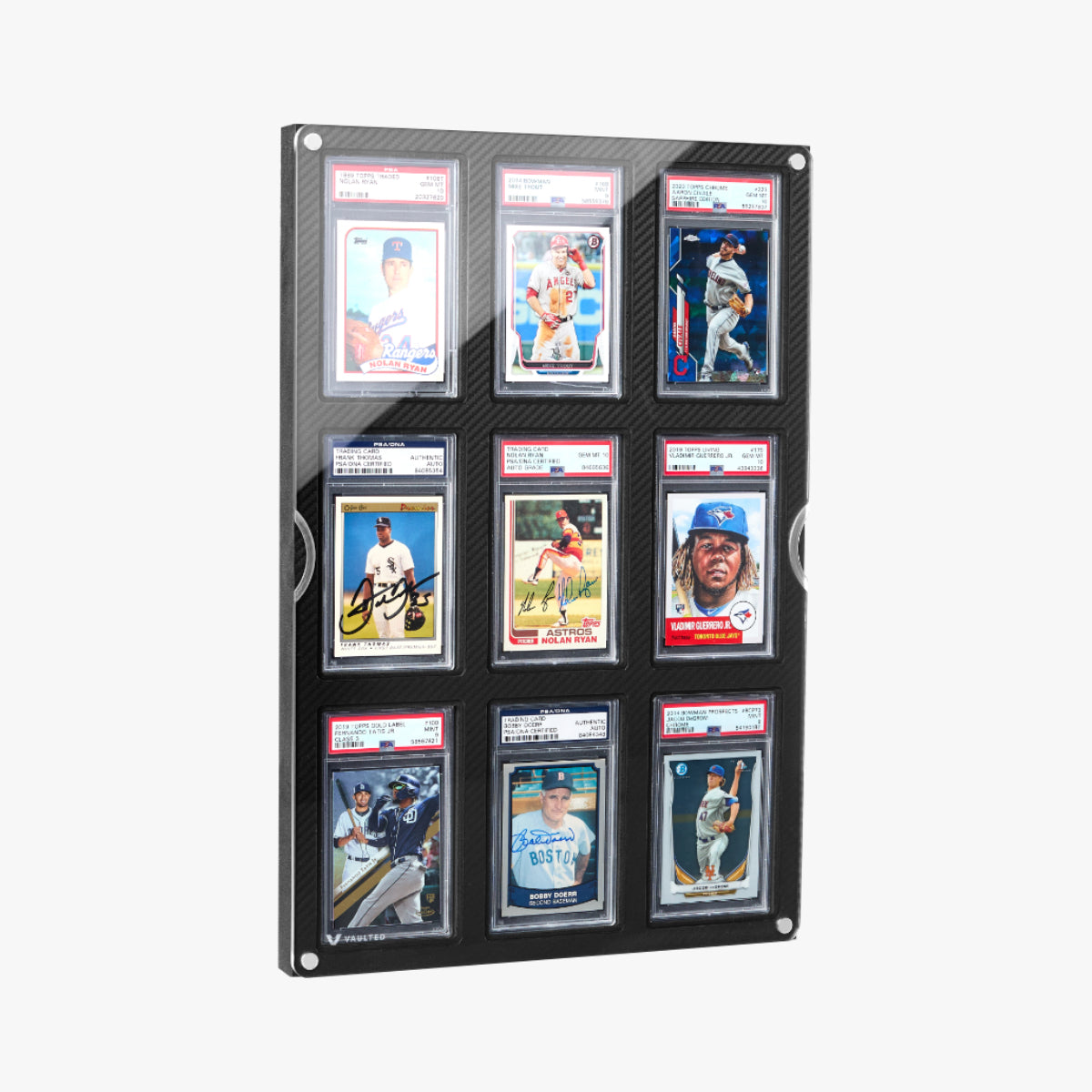
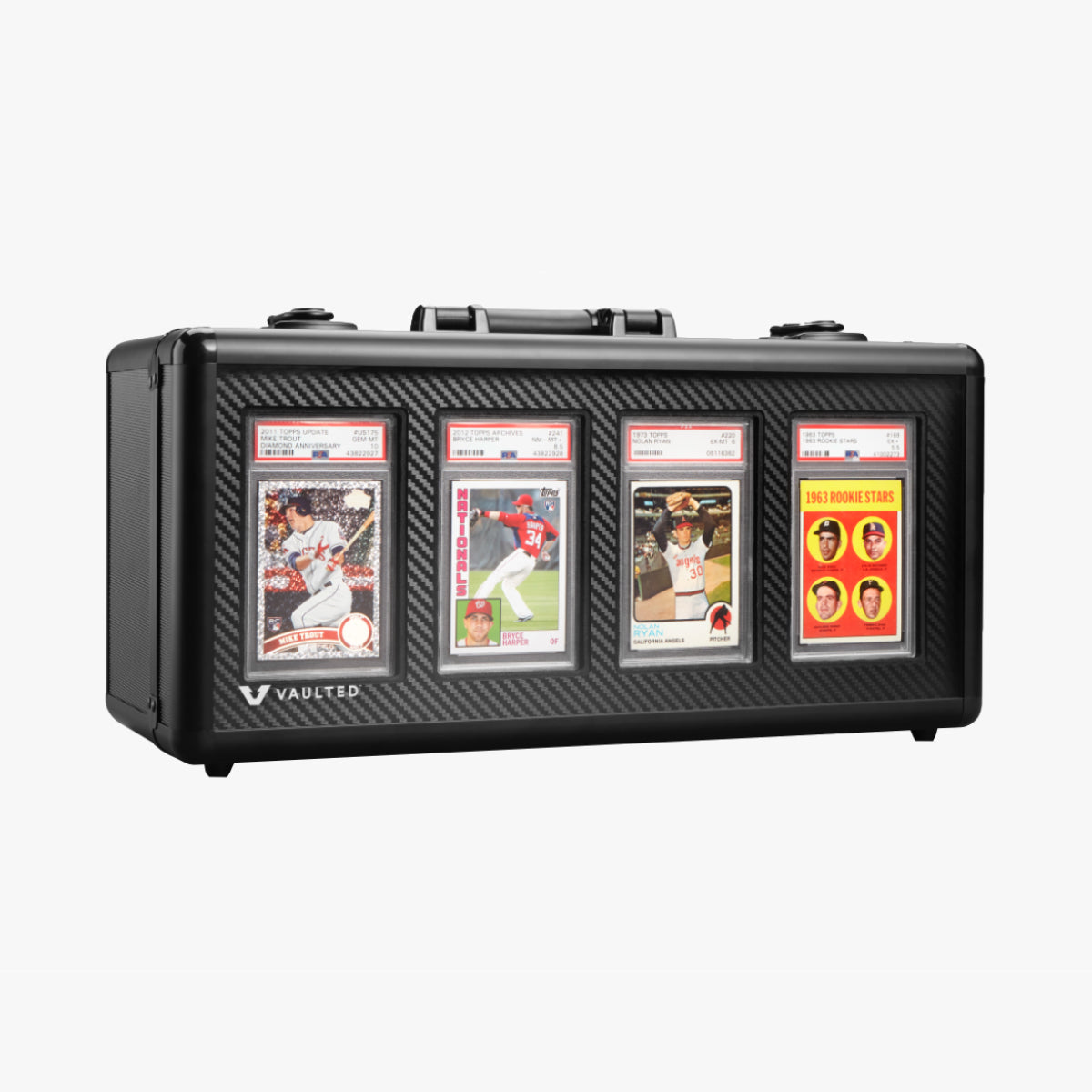
Vaulted Collection's baseball display cases are engineered specifically for long-term preservation of signed baseballs. Each case features UV-blocking construction, precision-machined closures, and archival-grade interior materials, designed to protect not just for years, but for decades.
Ideal Storage Conditions
If displaying your ball, follow these environmental guidelines:
-
Temperature: 65–70°F (18–21°C), stable. Avoid rooms with dramatic temperature swings.
-
Relative humidity: 45–55%. A hygrometer costs less than $20 and is worth having in any room with significant memorabilia.
-
Light: Keep the display case away from direct sunlight and minimize exposure to artificial UV sources (fluorescent lighting). UV-filtered LEDs are the preferred lighting option.
-
Location: Interior walls are more temperature-stable than exterior walls. Avoid basements (humidity) and attics (temperature extremes).
How Vaulted Collection Display Cases Are Designed for Long-Term Preservation
At Vaulted Collection, our baseball display cases represent the result of working directly with serious collectors who store irreplaceable pieces. Each case is designed around one core principle: your signed baseball should look exactly the same in 30 years as it does on the day you first place it inside.
Our cases feature UV-filtering construction that blocks over 99% of ultraviolet radiation, the same standard used in museum display environments. The interior cradle holds the ball at the ideal presentation angle without contact pressure on the seams. And the precision-engineered lid closure creates a stable microenvironment that buffers against external humidity fluctuations.
For a babe ruth autographed baseball, an object that has survived 70 to 100 years already, the right display case is what ensures it survives 70 more.
Displaying vs. Storing: When to Show It Off and When to Vault It
Not every piece needs to be on display. For the highest-value items, such as a Ruth ball graded PSA 8 or above, serious collectors often maintain two states: a display environment for everyday enjoyment, and long-term archival storage (acid-free box, dark, temperature-controlled) for periods when the piece won't be viewed.
A common approach: display the ball in a UV-protected case in a climate-controlled room, and move it to archival storage if you're away for extended periods, renovating, or if the room conditions change seasonally. The goal is minimizing cumulative exposure to the degradation factors outlined above.
Frequently Asked Questions About Babe Ruth Autographed Baseballs
Is a Babe Ruth autographed baseball a good investment?
Historically, yes, among the most consistently appreciating assets in the entire collectibles market. Consider the 1939 Hall of Fame ball: it sold at Christie's for $55,000 in 1997 and realized $632,369 at SCP Auctions in 2018, a more than tenfold increase in 21 years. Ruth's market has never seen a sustained decline. Supply is fixed (Ruth passed away in 1948), demand grows with each generation of collectors, and the cultural relevance of the name shows no signs of fading. As with all collectibles, condition and authentication are everything: a poorly preserved or unauthenticated ball carries a fraction of the value of a graded, documented example.
How do I know if my Babe Ruth baseball is authentic?
Submit it to PSA or JSA for professional authentication. Do not rely on seller-provided COAs, family stories, or informal assessments, as Ruth is the most forged autograph in sports memorabilia. Authentication costs a fraction of the ball's value and is the only way to establish credibility for future sale or insurance purposes.
What is the most expensive Babe Ruth signed baseball ever sold?
The most expensive single-signed Ruth baseball is the PSA/DNA Mint+ 9.5 example that sold at Heritage Auctions in 2012 for $388,375. The most expensive signed baseball of any kind featuring Ruth's autograph is the 1939 first Hall of Fame induction ball (signed by 11 inductees), which sold in 2018 for $632,369, a world record for any non-game-used signed baseball.
Can I insure a Babe Ruth autographed baseball?
Yes, and you should. Specialized collectibles insurance (through carriers like Chubb, AXA Art, or Berkley One) covers authenticated sports memorabilia for agreed value, meaning you receive the appraised amount in the event of loss, theft, or damage, not a depreciated replacement cost. A current PSA or JSA certification and a professional appraisal are typically required for coverage. Standard homeowner's insurance will not adequately cover high-value memorabilia.

