
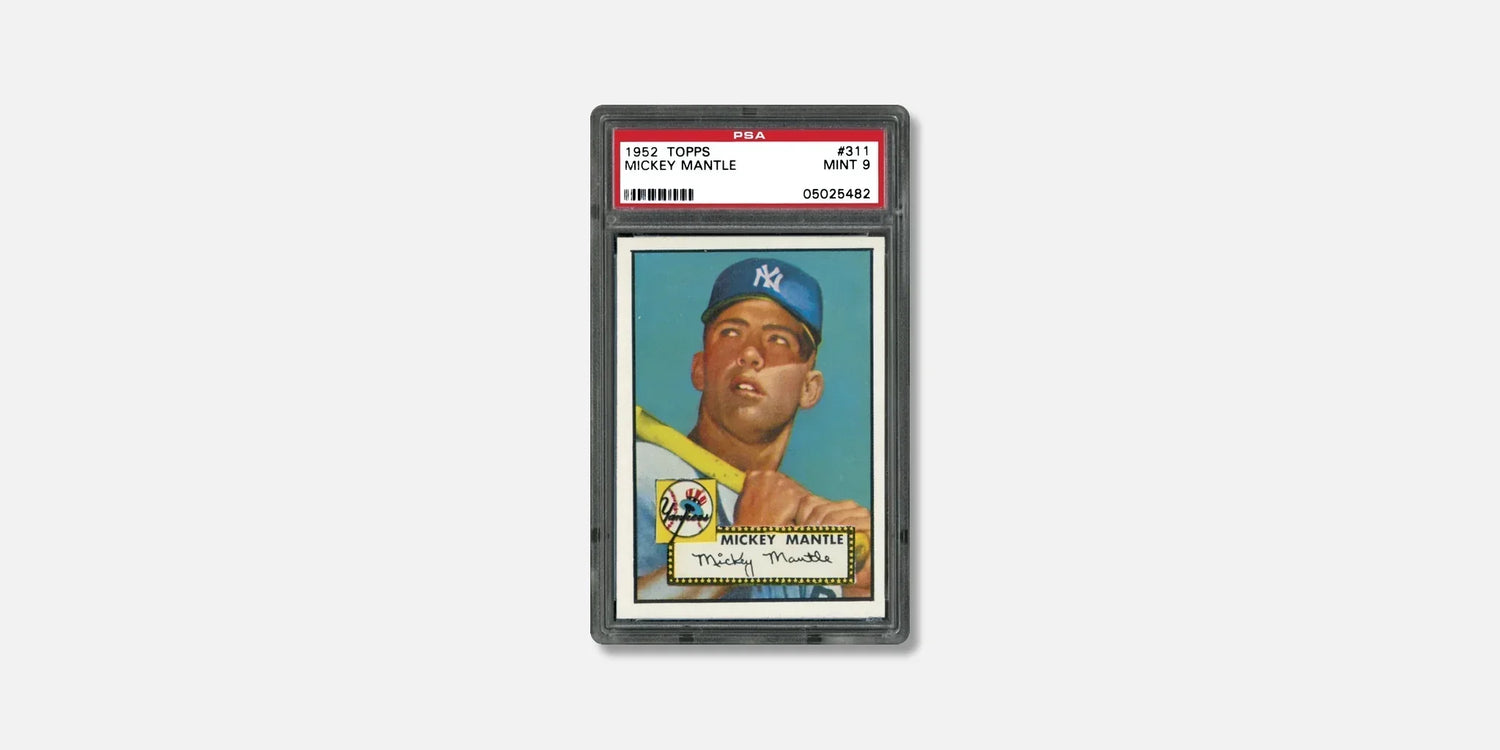
The 1952 Topps Mickey Mantle: The Most Iconic Postwar Baseball Card

Last updated: July 2026.
For most collectors, it is the card you know before you know the market. Then you learn what it actually costs — and why.
The 1952 Topps Mickey Mantle #311 is not the rarest vintage baseball card. It is not Mantle's rookie card. It is not the highest-graded postwar card in existence. But it is the most culturally resonant baseball card ever produced, and the market has proven that significance across seven decades of sustained collector demand.
A PSA 1 example — the lowest possible grade — sold for $53,283.50 in March 2026. A PSA 7 sold for $432,000 in December 2024. An SGC 9.5 sold for $12,600,000 in August 2022. The 1952 Topps Mickey Mantle commands premiums at every grade level, in every market condition, regardless of whether the broader hobby is booming or normalizing.
What follows is documented sales data across all grades, PSA population context, the rookie card myth, recent market activity including the 2026 Topps Series 1 pull, signed examples, grading considerations, and protection guidance for collectors who own or are considering one of the hobby's most significant cards.
Why the 1952 Topps Mickey Mantle Matters
The 1952 Topps set revolutionized baseball cards. For the first time, cards were larger — 2⅝" x 3¾" instead of the smaller formats that had dominated the prewar and early postwar era. They were colorful. They highlighted the team logo prominently. They focused on the player's face rather than full-body poses or action shots. The design was bolder, more modern, and more collectible than anything that had come before it.
Card #311 in that groundbreaking set arrived at the exact moment Mickey Mantle was ascending from promising rookie to generational talent. By the time the sixth series of 1952 Topps baseball cards hit the market, he was already a New York Yankees fixture and a future Hall of Famer in the making.
Mantle's cultural stature grew beyond baseball. He became a symbol of postwar American optimism, New York dominance, and the glamour of professional sports in the television age. The card became the visual shorthand for that legacy. When collectors think "vintage baseball card," this is the image that surfaces first.
The sustained market performance across all grade levels proves that significance is real, not manufactured. This card has survived every hobby cycle — booms, corrections, speculation waves, grading company shifts — and remained the single most sought-after postwar baseball card in the hobby.
Not Actually Mantle's Rookie Card
The 1952 Topps Mickey Mantle is not Mantle's rookie card. That distinction belongs to the 1951 Bowman, which was released a full year earlier.
Serious collectors know the difference. The 1951 Bowman is Mantle's true rookie — his first officially licensed baseball card. The 1952 Topps came later, during his second season with the Yankees.
Why did the 1952 Topps become more iconic than the actual rookie card?
Design. The 1952 Topps set was revolutionary. The 1951 Bowman, while significant, used a smaller format and a painted portrait style that felt more like the previous decade's aesthetic. The 1952 Topps looked like the future.
Timing. By 1952, Mantle's star was rising. The 1951 Bowman captured him as an unproven prospect. Card #311 captured him as a Yankee regular with growing national recognition.
Set status. The 1952 Topps set is widely regarded as the most important postwar baseball card set ever produced. Being the centerpiece of that set mattered more than being the earliest card.
The 1951 Bowman is valuable and historically significant. But when collectors say "the Mantle," they mean the 1952 Topps.
The 1952 Topps Set and High Number Series Context
Understanding why the 1952 Topps Mickey Mantle baseball card is scarce requires understanding how the 1952 Topps set was produced and distributed.
The set was released in six different series throughout 1952. Card #311 opened the sixth and final series. That series, often called the "high number series," had a lower print run than the earlier series. By the time the sixth series reached stores, baseball season was ending, collector demand was cooling, and Topps printed fewer cards.
This explains why high-number cards from the 1952 Topps set are generally scarcer than cards from the first five series. It is a documented production reality: fewer cards printed, fewer cards surviving in collector hands today.
The story that cases of 1952 Topps high-number cards were dumped into the Hudson River is hobby lore, often attributed to former Topps executive Sy Berger. That story has circulated for decades but has never stood up to serious scrutiny. No primary documentation exists. No warehouse records confirm it.
The Hudson River story is compelling. It may even be partially true. But it is not proven, and serious collectors should understand the difference between documented scarcity (lower print run, sixth series timing) and unverified legend.
The 1952 Topps Mickey Mantle is scarce because it was printed in lower volume than earlier-series cards.
How Rare Is the 1952 Topps Mickey Mantle?
PSA has graded 2,075 examples of card #311. That total includes all grades from PSA 1 through PSA 10, encompassing every example submitted to PSA since the company began grading cards.
That number places the 1952 Topps Mickey Mantle as the sixth most graded card in the entire 1952 Topps set. Five other cards have been graded more frequently: Yogi Berra, Bob Feller, Willie Mays, Duke Snider, and Warren Spahn.
This is not the rarest vintage card. It is not even the rarest card in its own set. But rarity alone does not determine value. Cultural significance, player legacy, design importance, and sustained collector demand matter more than population count in isolation.
The 1952 Topps Mickey Mantle commands higher prices than cards with lower PSA populations because it is the hobby's central trophy. Collectors want it more.
The Three PSA 10 Examples

Only three PSA 10 examples exist. These are the absolute ceiling of the card's population — perfect centering, perfect corners, perfect surface, perfect edges.
No documented public sales exist for PSA 10 examples at the valuation levels often referenced in YouTube commentary and hobby speculation. Reports of $30 million to $50 million valuations circulate, but these figures are theoretical — not auction results, not verified private transactions.
The three PSA 10 examples are owned privately and have not appeared at public auction in recent years. They exist more as market benchmarks than active trade comparables. When one eventually sells, it will set a new record. Until then, the SGC 9.5 sale at $12,600,000 remains the highest publicly documented transaction.
1952 Topps Mickey Mantle Sales by Grade
What the 1952 Topps Mickey Mantle actually sells for depends on grade. The price range is massive: from approximately $44,000 for a PSA 1 to $12,600,000 for an SGC 9.5. Below is the documented sales data organized by grade level, showing what collectors have paid at auction and through verified private sales.
| Grade | Sale Price | Date | Platform |
|---|---|---|---|
| SGC 9.5 | $12,600,000 | August 2022 | Heritage Auctions |
| SGC 7 | $579,500 | June 2026 | Goldin |
| PSA 7 | $432,000 | December 2024 | Heritage Auctions |
| PSA 7 | $264,000 | October 2024 | Heritage Auctions |
| PSA 4 | $105,000 | March 2024 | The Philly Show |
| PSA 2 | $75,000 | March 2024 | The Philly Show |
| PSA 1 | $53,283.50 | March 2026 | Goldin |
| PSA 1 | $43,920 | January 2026 | Goldin |
The floor for even the lowest-grade examples is approximately $44,000. The ceiling for the highest-documented sale is $12,600,000. Between those extremes, the market is active and liquid across all grade levels. Mid-grade examples in PSA 4 through PSA 7 represent the most accessible entry point for serious collectors who want to own the card without competing at the seven-figure level.
The Record-Breaking SGC 9.5 Sale

The current public auction record for the 1952 Topps Mickey Mantle is $12,600,000, set in August 2022 at Heritage Auctions. The card was graded SGC 9.5 — the highest grade SGC offers below a perfect 10 Pristine.
This sale established the 1952 Topps Mantle as one of the most valuable trading cards ever sold at public auction. The SGC 9.5 grade placed it among the finest known examples — near-perfect centering, sharp corners, clean surface, and exceptional eye appeal.
No higher-graded example has sold publicly since. The three PSA 10 examples remain privately held. Until one of those surfaces, the SGC 9.5 Heritage sale remains the comp all other high-grade examples reference.
Mid-Grade Market: PSA 4 Through PSA 7

The mid-grade range — PSA 4 through PSA 7 — represents the most accessible entry point for collectors who want to own the 1952 Topps Mickey Mantle without competing at seven figures.
PSA 7 examples have sold for $264,000 to $432,000 over the past two years. The range reflects condition nuances that matter significantly at this grade level: centering, print quality, surface cleanliness, and corner sharpness all influence where within that range a specific example lands.
An SGC 7 sold for $579,500 in June 2026 at Goldin — demonstrating that collectors will pay premiums for mid-grade examples with exceptional eye appeal. Strong centering and clean surfaces distinguish the best PSA 7 and SGC 7 examples from weaker ones at the same numerical grade.
PSA 4 examples sold for $105,000 in March 2024. These grades represent genuinely accessible collecting for buyers with six-figure budgets rather than seven-figure ones.
Eye appeal matters significantly at these grade levels. A well-centered PSA 4 with clean surfaces can be preferred over a poorly-centered PSA 6 by collectors who prioritize visual presentation over numerical grade. Visual quality — how it looks in person, not just what the label says — drives real purchasing decisions in the mid-grade market.
Entry-Level Examples: PSA 1-3

Even the lowest-grade examples of the 1952 Topps Mickey Mantle command five-figure prices. PSA 1 examples — the absolute floor of the graded population — have sold for $43,920 to $53,283.50 in early 2026 at Goldin.
A PSA 2 sold for $75,000 in March 2024 at The Philly Show.
These are not "affordable" in absolute terms. But they represent the entry point for collectors who want to own the card regardless of condition. A PSA 1 or PSA 2 example carries the same cultural weight, the same historical significance, and the same status as a centerpiece collectible — just at a price point accessible to collectors who cannot compete for PSA 7 or higher examples.
Low-grade examples often show significant wear: creased corners, surface scratches, centering issues, and fading. But the image remains recognizable. For many collectors, ownership matters more than condition.

Signed 1952 Topps Mickey Mantle Cards

Signed examples of the 1952 Topps Mickey Mantle represent a distinct and exceptionally valuable segment of the market. PSA lists 21 signed examples in its population report as of August 2025 — a small subset of the overall 2,075 graded cards.
These signed examples command significant premiums over unsigned cards at the same grade level. The autograph transforms even low-grade examples into seven-figure collectibles.
Recent documented sales of signed 1952 Topps Mickey Mantle cards include:
| Grade | Sale Price | Date | Platform |
|---|---|---|---|
| PSA 5 Auto 8 | $1,067,500 | August 2025 | Heritage Auctions |
| PSA 1 Auto 8 | $945,500 | December 2025 | Heritage Auctions |
| PSA 3 Auto 10 | $793,006 | December 2024 | Goldin |
| PSA 1 Auto 8 | $264,000 | August 2024 | Heritage Auctions |
| PSA 1 Auto 10 | $264,000 | August 2023 | Heritage Auctions |
| PSA Authentic Auto 10 | $192,000 | December 2024 | Heritage Auctions |
A PSA 1 Auto 8 — the lowest card grade combined with a strong autograph grade — sold for $945,500 in December 2025 at Heritage Auctions. That price is more than double what an unsigned PSA 7 example sold for in the same general timeframe.
A PSA 5 Auto 8 sold for $1,067,500 in August 2025, also at Heritage Auctions. This represents the highest publicly documented sale for a signed mid-grade example in recent years.
The autograph grade matters as much as the card grade. PSA grades autographs on a separate 1–10 scale. An Auto 10 (perfect signature quality) commands a premium over an Auto 8, even on the same card at the same card grade. Collectors evaluating signed examples should consider both the card condition and the signature quality as independent value drivers.
The 2026 Topps Series 1 Redemption Pull

In early 2026, Topps inserted an actual 1952 Topps Mickey Mantle — not a reprint, not a commemorative card, but a real vintage example — into packs of 2026 Topps Series 1 Baseball via redemption.
The card was graded PSA 5 before insertion. A collector pulled the redemption and redeemed it for the actual vintage card. This was a documented modern insertion, not speculation or rumor.
The insertion renewed mainstream attention on the 1952 Topps Mickey Mantle and demonstrated Topps' recognition of the card's iconic status. Inserting a card worth six figures into modern retail product is unprecedented. It created significant collector buzz throughout early 2026 and drove substantial interest in 2026 Topps Series 1 product.
The PSA 5 grade placed it in the mid-grade range, accessible enough that the pull felt attainable to collectors opening retail product, yet valuable enough to generate real excitement.
Grading the 1952 Topps Mickey Mantle
Understanding how the 1952 Topps Mickey Mantle is graded helps collectors evaluate examples at different price points and make informed purchasing decisions.
The most common condition challenge is centering. The 1952 Topps set is notoriously off-center — production quality control was inconsistent, and many cards were printed with the image shifted toward one side or one corner. Centering problems are the single biggest factor preventing most examples from grading PSA 8 or higher.
A well-centered example is rare. When one appears, it commands a premium within its grade. Collectors evaluating PSA 7 examples should compare centering across multiple cards at the same grade — a well-centered PSA 7 with clean surfaces can be more desirable than a poorly-centered PSA 8.
Print quality matters. Some examples show print defects, spotting, or color inconsistencies from the original production run. These flaws are not condition issues — they are manufacturing characteristics — but they still affect grade and eye appeal. A card with clean, consistent printing will grade higher and sell for more than one with visible print spots.
Corner wear is the second most common issue. Corners on vintage cards degrade quickly when handled, stored improperly, or exposed to humidity. Sharp corners are essential for PSA 8+ grades. Even slight rounding or fraying at the corners drops a card from Mint consideration to Near Mint or lower.
Surface issues include scratches, scuffs, and loss of gloss. The 1952 Topps cards used a coated stock that scratches easily. A card with a clean, glossy surface stands out immediately. Surface quality, combined with centering and corners, determines whether a card reaches PSA 9 or PSA 10.
Why are PSA 8+ examples so rare? All four grading criteria — centering, corners, edges, surface — must be near-perfect simultaneously. Most surviving examples fail on centering alone. The few that pass centering often have corner wear or surface issues. The result: fewer than a handful of PSA 9 examples exist, and only three PSA 10s.
Protecting and Displaying a 1952 Topps Mickey Mantle
A card worth six or seven figures deserves protection that matches its value. UV exposure, handling, humidity, and temperature fluctuations all pose risks to long-term preservation.
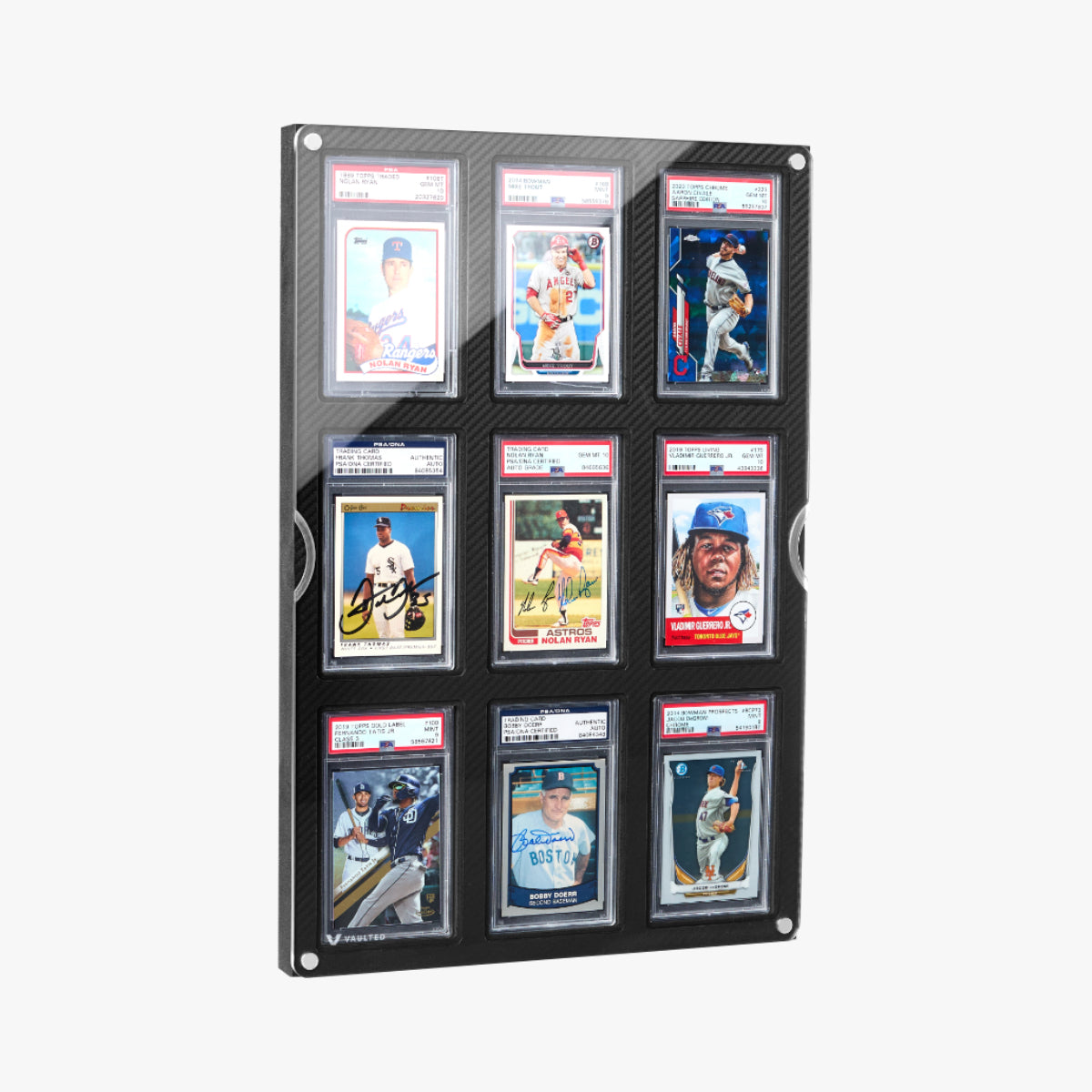
UV light fades card color and ink over time. Even graded slabs should not be treated as dedicated UV-protective storage. For display, UV-protective display designed specifically for PSA graded cards provides built-in protection while showcasing the card prominently.
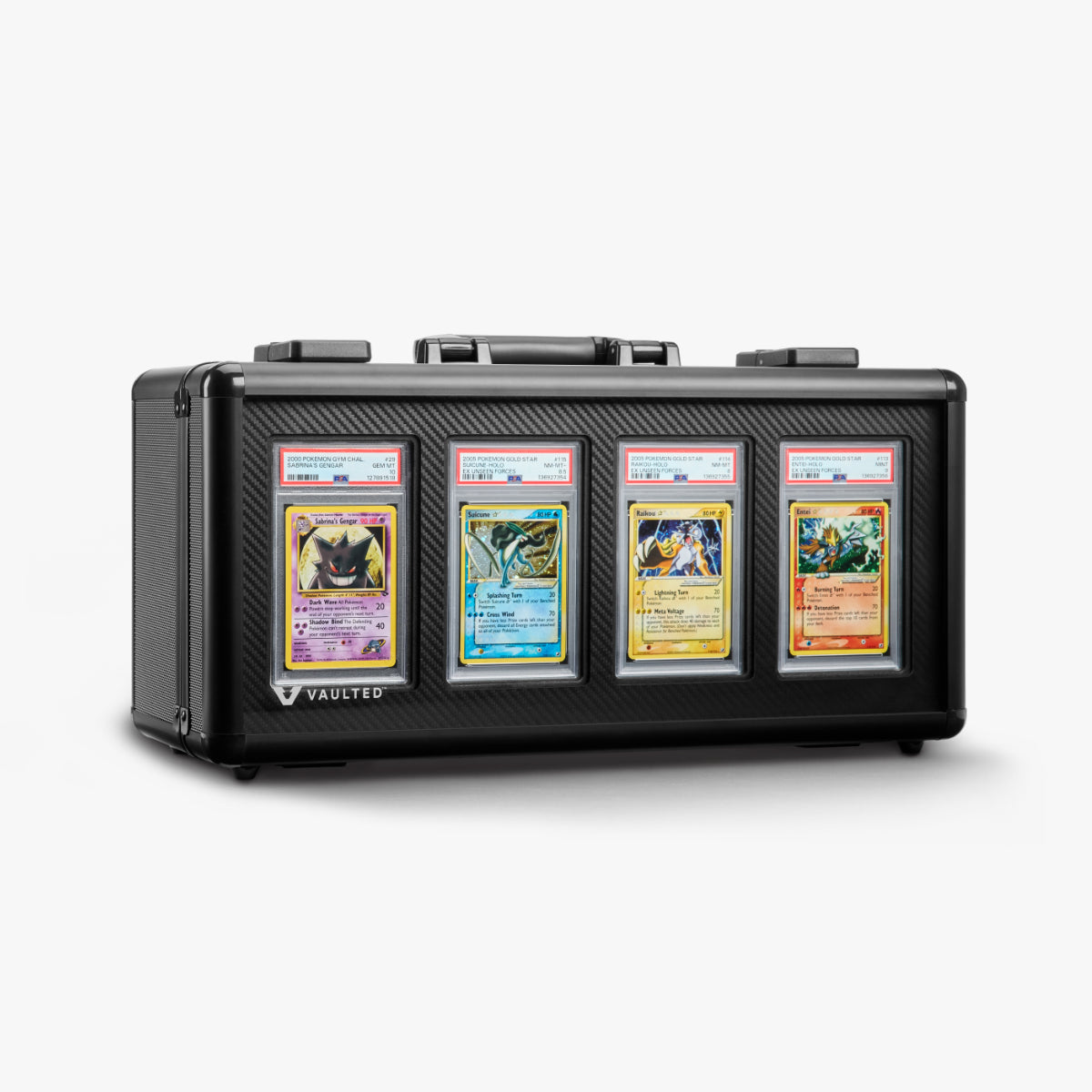
For storage rather than display, fully enclosed cases offer additional protection. The Vaulted Card Case (4-Row) holds up to 112 PSA slabs with organized internal rows and a hard-shell exterior that protects against physical impact.
Handling should be minimized. Even in a graded slab, repeated handling risks drops, impacts, and slab damage. Once a card is graded and slabbed, it should be stored or displayed — not passed around repeatedly.
Room conditions matter. Avoid storing or displaying graded cards in rooms with significant natural light, high humidity, or temperature swings. A dedicated card room or climate-controlled space is ideal. Avoid garages, attics, basements, and rooms near windows.

Why the 1952 Topps Mickey Mantle Remains the Hobby's Holy Grail
The 1952 Topps Mickey Mantle endures because it is not just scarce, not just beautiful, and not just valuable. It is the card collectors keep returning to when they try to explain why cardboard can matter.
The 1952 Topps set revolutionized card design. Mantle became one of baseball's most iconic figures. The card captured him at the exact moment he was ascending to greatness. The design, the player, the timing — everything converged.
Decades later, the card endures. A PSA 1 sells for more than $40,000. A PSA 7 sells for hundreds of thousands. An SGC 9.5 sold for $12,600,000. The market has spoken consistently across every grade level, in every market condition, for seven decades.
Frequently Asked Questions About the 1952 Topps Mickey Mantle
Is the 1952 Topps Mickey Mantle his rookie card?
No. The 1952 Topps Mickey Mantle is not Mantle's rookie card — the 1951 Bowman, released a full year earlier, holds that distinction. However, the 1952 Topps became more iconic due to its revolutionary design, larger format, and Mantle's rising cultural stature by 1952. Serious collectors know the distinction, but the 1952 Topps remains the most significant Mantle card in the hobby.
How many PSA 10 examples of the 1952 Topps Mickey Mantle exist?
Only three PSA 10 examples exist. These represent the absolute ceiling of the card's population — perfect centering, perfect corners, perfect surface, and perfect edges. No PSA 10 example has sold at public auction in recent years. The highest publicly documented sale is an SGC 9.5 that sold for $12,600,000 in August 2022 at Heritage Auctions.
What is the cheapest 1952 Topps Mickey Mantle I can buy?
The entry point for a graded example is approximately $44,000 to $53,000 for a PSA 1 — the lowest possible grade. Recent Goldin sales show PSA 1 examples selling for $43,920 to $53,283.50 in early 2026. Even at the lowest grade, this card commands five-figure prices due to its cultural significance and sustained collector demand.
Why is the 1952 Topps Mickey Mantle so expensive if it's not that rare?
Cultural significance drives value more than rarity alone. PSA has graded over 2,000 examples, making it the sixth most graded card in the 1952 Topps set. But it is the most iconic postwar baseball card ever produced — the card that defines the hobby. Collectors want it more than any other vintage card, and that sustained demand is what creates the premium at every grade level.
Should I get my raw 1952 Topps Mickey Mantle graded?
If you own a raw example, grading is worth serious consideration — especially if the card has strong centering, clean surfaces, and sharp corners. Grading authenticates the card, protects it in a tamper-evident holder, and establishes a verifiable grade that buyers trust. Submission costs and turnaround times vary by grading company, but for a card of this value, professional grading adds significant market credibility.
What's the difference between PSA and SGC grading for the 1952 Topps Mickey Mantle?
PSA uses whole-number grades only (PSA 1 through PSA 10). SGC uses half-point increments and has two distinct top grades: SGC 10 Gem Mint and SGC 10 Pristine. The record-setting $12,600,000 sale was an SGC 9.5, demonstrating that high-grade SGC examples command the same market respect as PSA examples. Both companies are widely trusted for vintage cards. Collectors should evaluate centering, eye appeal, and overall card quality rather than focusing solely on the grading company.
Can I display a six-figure card without damaging it?
Yes, with proper UV-protective display products designed specifically for graded slabs. UV light fades card color and ink over time. Even graded slabs should not be displayed near windows or in rooms with significant natural light unless UV-protective materials are used. Explore Vaulted's wall-mount displays built specifically for PSA slabs, which include UV-protective options designed to protect high-value cards while showcasing them prominently.